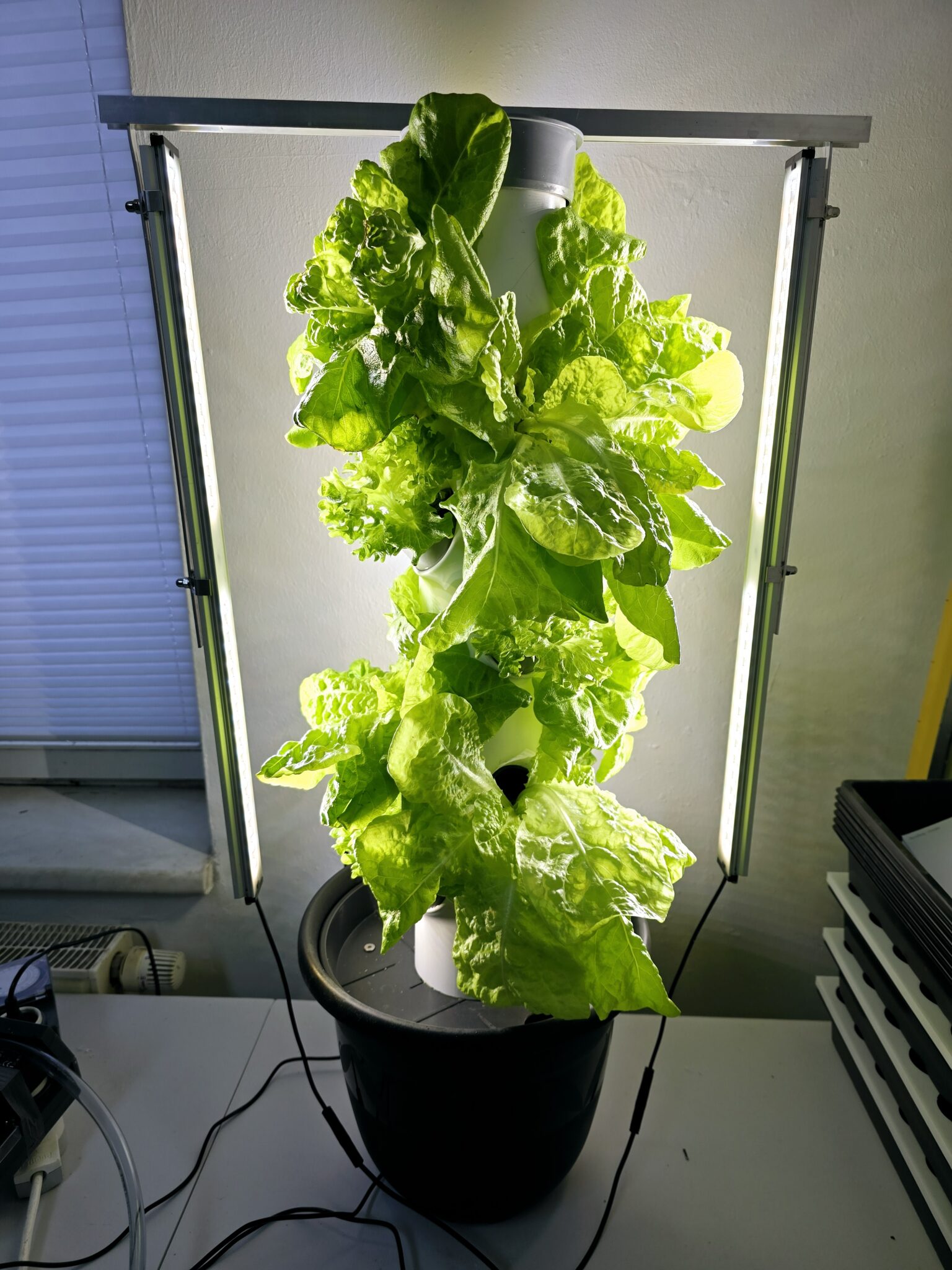
EC value in hydroponics: how much nutrient your plant needs
What the EC value measures, which values you need in which phase and how I mix my nutrient solution without lengthy calculations.
The EC value shows the nutrient concentration in your solution. Learn how to measure and set it correctly for ideal plant growth in every development phase.
What is the EC value?
The EC value (electrical conductivity) measures the concentration of dissolved salts, i.e. the nutrients, in your nutrient solution. It’s given in millisiemens per centimetre (mS/cm). The higher the EC, the more nutrient salts are dissolved in the water.
What the EC value measures
The EC shows how many salts are dissolved in your water. More nutrient means a higher EC. So it tells you how much is in there, but not which nutrients exactly. That’s why you need a good nutrient and the meter together.
Some devices show mS/cm, others µS/cm. 1.2 mS/cm is the same as 1200 µS/cm. The ppm value is only an estimate that every device converts differently. Only EC and pH count for you.
EC scale: from low to high (mS/cm)
- Distilled water
- RO water
- soft tap water without nutrient
- Young seedlings
- First weeks
- Established seedlings
- Early growth phase
- Leaf development
- Stem growth
- Flower formation
- Fruit development
- Leafy plants up to 1.6 at harvest, fruiting vegetables 2.0 to 2.5
- Salt stress
- Root damage
Visual EC scale
🎯 Hydroponics sweet spot
Problem ranges
EC above 2.5: salt stress and root damage
Importance for the plants
Nutrient supply
The EC shows how many nutrients are available to the plants. If the value is too low, they suffer deficiencies.
Growth phases
Young plants and seedlings need lower EC values than fully grown plants in the flowering or fruiting phase.
Ideal development
Only in the right EC range can plants reach their full potential and deliver maximum yields.
EC too low:
EC too high:
Optimal EC values and typical problems
EC values by plant stage
Examples for specific plants
EC values by growth phase
A simple rule of thumb for any nutrient: seedlings a quarter, young plants half, growth three quarters and at harvest or fruiting the full value.
| Plant | Seedlings | Young plant | Growth | Harvest / fruit |
|---|---|---|---|---|
| Lettuce | 0.4 | 0.8 | 1.2 | 1.6 |
| Basil | 0.4 | 0.8 | 1.2 | 1.6 |
| Kohlrabi | 0.6 | 1.1 | 1.7 | 2.2 |
| Peppers | 0.5 | 1.0 | 1.5 | 2.0 |
| Tomato | 0.6 | 1.3 | 1.9 | 2.5 |
| Cucumber | 0.6 | 1.3 | 1.9 | 2.5 |
My values with my nutrient
This is how much EC my own liquid nutrient gives with my soft water. The millilitres are only the starting value, the meter decides.
| Nutrient per litre | Total EC for me | Stage |
|---|---|---|
| 0.5 ml | 0.4 to 0.5 | first true leaves |
| 1 ml | 0.6 to 0.8 | Young plant |
| 1.5 ml | 0.8 to 1.0 | |
| 2 ml | 1.0 to 1.2 | strong plant |
| 2.5 ml | 1.2 to 1.4 | |
| 3 ml | 1.4 to 1.6 | fully grown |
These amounts only apply to Frankie’s liquid nutrient. With a different nutrient, use its instructions and the rule of thumb above. For your exact value, use the nutrient calculator.
Related:Calculating nutrient: my nutrient calculator for your amount of water›
Seedling and leaf nutrient from one bottle, with calcium and magnesium, made for soft water. For all plants from sowing to the growth phase, leafy plants until harvest.
View in the shop ›Measuring and setting EC correctly
Tips for measuring EC
Timing
- ✔Daily at the same time
- ✔Measure after every feeding
- ✔Check at every water change
Temperature
- ✔Optimal: 20 to 25 °C
- ✔Temperature affects EC
- ✔Use automatic compensation
Procedure
- ✔Rinse the electrode well
- ✔Stir the solution
- ✔Let the value stabilise
Meters I use
I have three devices: a beginner pen for about 40 euros that shows µS/cm, a quality pen with app and a monitor that stays in the water permanently. A simple combination meter for EC and pH is completely enough to start with.

* Affiliate-Link: Bei einem Kauf erhalte ich eine Provision, dein Preis bleibt gleich. Preis inkl. MwSt., zzgl. Versand, Stand 8.11.2026. Bilder: Amazon Creators API

* Affiliate-Link: Bei einem Kauf erhalte ich eine Provision, dein Preis bleibt gleich. Preis inkl. MwSt., zzgl. Versand, Stand 8.11.2026. Bilder: Amazon Creators API

* Affiliate-Link: Bei einem Kauf erhalte ich eine Provision, dein Preis bleibt gleich. Preis inkl. MwSt., zzgl. Versand, Stand 8.11.2026. Bilder: Amazon Creators API
* Affiliate links: I earn a commission if you buy, your price stays the same.
Affordable, easy to use and perfectly adequate for beginners.
View on Amazon* ›* Affiliate link: I earn a commission if you buy. Your price stays the same.
Adjusting the EC value correctly
Step-by-step guide
Measuring
Determine the current EC value
Adjust
Add nutrients or water
Mix
Mix the solution well
Check
Measure again and adjust
Mixing nutrient solution: how I do it
For 0.5 ml per litre I fill the 10 litre watering can with about 3 litres of water, add 5 ml of nutrient and then fill up. My meter then shows about 0.45. For large amounts I add the nutrient with a syringe under the running water, leave the meter in and turn off the tap as soon as the target EC is reached.
- EC too high: dilute with water.
- EC too low: add nutrient, in small steps.
Important note:
Pro tips for stable EC values
- Always take the starting water EC into account
- Evaporation leads to EC rising
- If the plant takes up more nutrients than water, the EC falls; usually it rises because the plant drinks more water
- Regular water changes stabilise
- Use quality nutrients
- Calibrate the meter regularly
- Keep temperature constant
- Records help with optimising
Why the EC value changes
Plants take up more water than nutrient. So when the water level drops, the EC rises. In the tower I top up with ready-mixed nutrient solution. If the value keeps rising for no reason or deficiency signs show, I change the solution completely. Outdoors the EC drops after rain, then I measure again.
A few questions about space, location and what you want to harvest, and you get a recommendation.
To the tower advisor ›Influence of the starting water
Take tap water into account
Tap water often already contains dissolved salts: always measure the starting water first, this value counts towards the total EC!
Example calculation:
Measure the tap water first
Before feeding, measure your plain tap water. My water in Falkenstein is very soft: about 4 degrees German hardness and an EC of 0.25. This value always counts towards the total EC.
| Water | EC without nutrient | Hardness (approx.) |
|---|---|---|
| soft | below 0.3 | below 8.4 °dH |
| medium | 0.3 to 0.5 | 8.4 to 14 °dH |
| hard | above 0.5 | above 14 °dH |
An example: with soft water (0.25) you still have 1.35 free for nutrient up to an EC of 1.6. With hard water (0.8) only 0.8 remains. The same amount of nutrient quickly gives too much there.
Related:How hard is your water? Look up water hardness by postcode (Germany)›Optimal
- RO water
- Distilled water
- Rainwater (filtered)
- soft tap water (like mine)
Acceptable
- Good tap water
- Well water (measure first)
- Can be used
Problematic
- Hard tap water
- RO system recommended
- Difficult dosing
RO water: the best choice for hard water
RO water is ideal for hydroponics because it contains almost no salts of its own and nutrient dosing can be controlled precisely.
If you have soft tap water below 0.3 mS/cm, you don’t need an RO system. RO water contains no calcium and magnesium, so the nutrient has to bring both. My liquid nutrient contains calcium and magnesium.
- Precise nutrient dosing
- No unknown salts
- Constant starting conditions
- Purchase costs
- Maintenance required
- Water waste
HydroFlex Tower for indoors and outdoors, seedling box, seedling station, support rings and my own nutrient. After you buy, I’ll help you on WhatsApp.
To the shop ›FAQ & practical tips
FAQ
How often to measure the EC value?
Daily, especially when changing systems or with new nutrient solutions.
Fluctuating EC values?
Causes: evaporation, plant growth or topping up water. Check regularly.
EC and pH at the same time?
Yes, many combination meters measure both. Both values are crucial.
Further reading
Conclusion
FAQ about the EC value
What does the EC value mean in hydroponics?
Which EC value is right for lettuce?
Which EC value is right for tomatoes?
Which EC value is right for peppers?
What’s the difference between mS/cm and µS/cm?
Do I have to include my tap water?
When is water considered soft?
Do I need RO water?
Why does the EC rise by itself?
What to do if the EC is too high?
What to do if the EC is too low?
How often do I need to calibrate the EC meter?
Do I need the ppm value?
Should I set the EC or the pH first?
Continue with your own growing

168 pages, simply explained for beginners and with videos on the topics (in German). Exactly how I grow myself: from sowing to harvest.
More about the book ›A few questions about space, location and what you want to harvest, and you get a recommendation.
To the tower advisor ›Questions about your setup? Message me on WhatsApp.
Tapping opens WhatsApp (provider: WhatsApp Ireland Ltd.). More in the privacy policy.