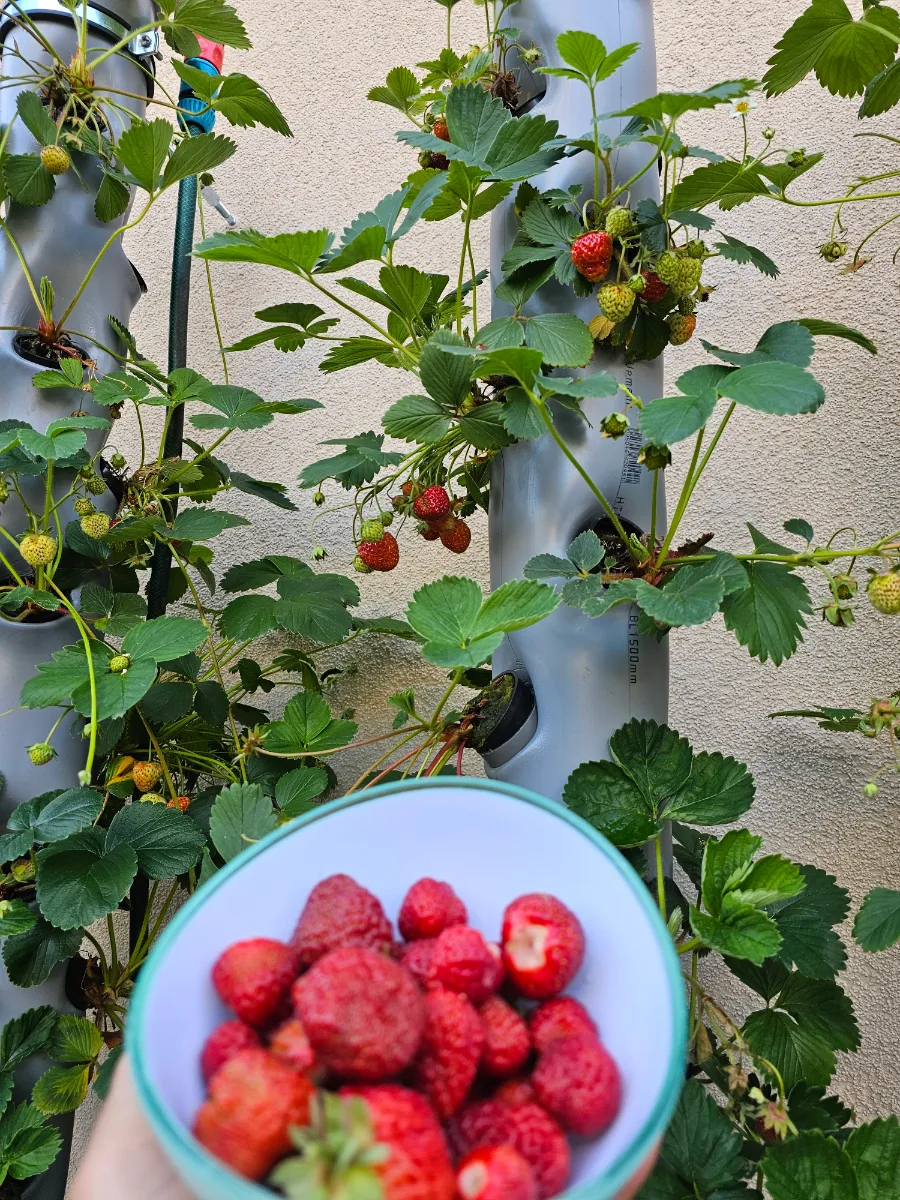
Strawberries under a grow light: light, lamps and day length
Purple or white, 12 or 16 hours, overwinter or harvest in winter? Here you find out what light your strawberries need indoors and how to set it up step by step.
frafon75 asked under my YouTube video (in German): which lamps do you use, which ones are any good, and for strawberries, purple or white?
My detailed answer is on this page. Do you have a question too? Here is how to ask ›
In short: the right light for strawberries
Strawberries grow really well indoors under a grow light, even in winter. Three things matter: enough light, the right day length and the right variety. The colour of the lamp matters less than many people think.
Overwinter or harvest in winter?
Before you buy a lamp, decide what you want to do with your strawberries in winter. Everything else depends on that.

Strawberries from seedling to harvest: growing strawberries hydroponically ›
The variety decides: everbearing or June-bearing
Strawberries decide when to flower based on the length of the night. There are two groups that behave in exactly opposite ways. That is why the variety matters so much for lighting.

You do not have to change the day length, the plants keep flowering, and you harvest over many weeks. June-bearing varieties are only worth it indoors if you specifically want one big harvest at once.
Purple or white: which grow light is any good?
I get asked this a lot. Red light is important for strawberries because it promotes flowers and fruit. But you do not need a colourful, purple lamp for that. Good white full-spectrum lamps already have the red built in, often with their own red diodes (660 nm), and some also with far red (730 nm).
White light with extra red is especially good for strawberries. In a trial with strawberries in a hydroponic system, supplemental lighting of red and white performed best. And far red (730 nm) increased the harvest of the variety Albion by almost half. That is why I add a lamp with extra red and far red for flowering.
What the individual light colours do: Lighting ›
In the chapter on light I explain step by step how much light your plants need, how to measure it and how to hang your lamp correctly.
View the book on Amazon*Light and fertiliser step by step
This is how you go about it indoors. You adjust light and fertiliser to the plant’s stage. The only important difference is the day length between the two variety groups.
When to switch from grow to bloom fertiliser: Grow or bloom fertiliser? ›


For June-bearing varieties that is exactly right, because the short days trigger flowering. For everbearing varieties it would be a mistake. They flower more with long days, and in trials the harvest dropped sharply with 12 hours of light. So check your plant label first.
My grow light recommendations for strawberries
You do not need an expensive professional setup for strawberries indoors. Slim bars are enough for seedlings and leaf growth. For flowers and fruit, add a stronger lamp with extra red.
For seedlings and leaves
 MARS HYDRO VG40 LED grow light 60 cm IP65Two slim bars with white full spectrum. Ideal at the side of the tower and for seedlings, waterproof.59,99 EURView on Amazon*To Amazon*
 Barrina T8 LED grow light 60 cm, pack of 4Four linkable bars, good for shelves and seedling stations. An affordable start for lots of young plants.74,99 EURView on Amazon*To Amazon*
* Affiliate link: if you buy, I receive a commission, your price stays the same. Prices incl. VAT, as of: 26.11.2026.
For flowers and fruit
 Barrina TX-L63 full-spectrum grow light with 730 nmWhite full spectrum with far red (730 nm), which promotes flowers and fruit in strawberries. Two panels for a large area.89,99 EURView on Amazon*To Amazon*
 MARS HYDRO TS1000 LED grow lightPowerful panel lamp with extra red diodes, dimmable. Enough for one strawberry tower in a grow tent.89,99 EURView on Amazon*To Amazon*
Measuring and controlling
 Quantum PAR meter (PPFD)Shows you exactly how much light reaches leaf height. So you reliably hit 300 to 350 PPFD.94,99 EURView on Amazon*To Amazon*
 Interval timer socketSwitches the lamp on reliably for 16 hours every day, even when you are not at home.15,98 EURView on Amazon*To Amazon*
Measuring light with a light meter
More light, suddenly everything grows
Want to grow strawberries indoors and not sure which tower suits you?
To the plant tower advisorCommon lighting mistakes with strawberries
Light values for all plants at a glance: Optimal light values ›
Related pages
Do you have a question? Did you enjoy the topic? Is something missing or do you see it differently? I am always learning and look forward to hearing about your experience. Write to me in the comments below.
FAQ: strawberries under a grow light
Do strawberries need red light?
Grow light for strawberries: purple or white?
How many hours of light do strawberries need indoors?
How much light do strawberries need?
Can I harvest strawberries indoors in winter?
How do I overwinter my strawberries?
Which strawberry varieties are best indoors?
What do 660 nm and 730 nm mean on grow lights?
When do I switch to bloom fertiliser?
How far should the lamp be from the strawberries?
Why does my strawberry have lots of leaves but hardly any flowers?
How do I pollinate strawberries indoors?
Sources and further reading
- Park, Sethi, Temnyk (2023): Growth, flowering and fruit production of strawberry Albion under 12 and 16 hour photoperiods, Plants
- Ries, Park (2024): Far-red light can enhance growth and fruit production of indoor strawberries, HortScience
- Chen et al. (2024): White and white-red LEDs compared with red-blue in strawberry, Frontiers in Plant Science
- Red and white supplemental light for hydroponic strawberries, Hortidaily
- Ohio State University: Flowering basics in strawberry
- Review on photoperiod in strawberry, Journal of the American Pomological Society
- Sønsteby (1997): Short-day period and temperature interactions on flowering of strawberry, Acta Horticulturae
- Sønsteby, Heide (2019): Short-day requirements of the late cultivar Malwina
- Lin, Barker, Kubota: Far-red light for short-day strawberries in indoor production, HortTechnology