Briefly on, longer off: how long my pump runs
How often the water in a hydro tower needs to run, which times I set indoors and outdoors, which timer suits this and why the air stone does not belong on the timer. Plus: NFT, Kratky and the tomato tower.
How often the water circulates in a hydroponic system is a crucial question for growing plants successfully. The watering frequency depends on various factors, such as the type of plant, the medium used and the specific requirements of your hydroponic system. In this article you will get valuable information and practical tips for determining the optimal watering frequency for your system. If you have questions or need support, I am happy to help, quickest via WhatsApp. Together we will find the best solution for your hydroponics!
How often does the water run in hydroponic systems?
Watering frequency in hydroponic systems is crucial for healthy plant growth. Unlike traditional growing in soil, success in hydroponics depends heavily on the right water supply. Different hydroponic systems, such as the hydro tower, the NFT system (Nutrient Film Technique) and the Kratky method, require different watering cycles adapted to the specific needs of the plants and the system requirements. In this article you will learn how often the water should run in these systems to ensure optimal growing conditions. We look at the special features of each system, highlight the pros and cons and give practical tips for correct watering. Discover how the right water management maximises the health and productivity of your plants and helps you avoid common mistakes.
In intervals
Normally 5 minutes on, 30 off. Only in great heat 15 on, 15 off.
Usually constant
A thin film of nutrient solution flows through sloping channels. Intervals only with residual water.
Without a water pump
The roots stand in the nutrient solution. With DWC air bubbles continuously.
Why the pump does not have to run all the time
In a hydro tower a small pump carries the nutrient solution from the container to the top. From there it trickles down through the segments, wetting the roots on the way. After that the roots stay moist for a long time. That is why the pump does not have to run all the time: short run times with longer breaks are quite enough.
The breaks even have an advantage. Roots need not only water and nutrients but also oxygen. Between two pump cycles air reaches the roots, and the plants look for their water themselves in between. That way they form strong roots. And the pump uses less electricity.
How long the pump runs depends mainly on the location: indoors at the window or outdoors in the sun. Here I show you my times, just as I describe them in my book.
Hydro tower, plant tower, plant column: how long the pump runs
In a hydro tower the water runs in intervals with the help of a small 8 watt pump: normally 5 minutes on and 30 minutes off. I only use the 15 minute cycle in great heat. This pump runs around the clock in an interval of 5 minutes on and 30 minutes off. You only set it to 15 minutes on and 15 minutes off in great heat, and then it goes back to 5 on and 30 off. Only above 40 °C in full sun do I let the pump run continuously, to supply the plants optimally with nutrients and water. In normal summer weather the intervals are enough.
1Indoors: 5 minutes on, 30 minutes off
My setting for windowsill, flat and seedling shelf.
Indoors my pump runs for 5 minutes, then pauses for 30 minutes. That repeats all day and all night. The roots stay moist, and the plants grow strongly. If the leaves look fresh and nothing droops, everything is fine.
Why not 15 on and 15 off?
You read the times 15 minutes on and 15 minutes off almost everywhere. I used to do it that way too. But indoors that is too long for me. Strawberries, for example, then stay wet too long. That is why indoors I go for short run times. For the heat outdoors, 15 minutes are just right.
2Outdoors in the heat: more water
Balcony, patio, garden and greenhouse.
If the tower stands outdoors in full sun, the plants evaporate much more water. Then you increase the pump times. In great heat I set it to 15 minutes on and 15 minutes off. If the lettuce leaves droop, water is missing. When it gets cooler again, I go back to 5 minutes on and 30 off.
I only let the pump run continuously above 40 °C in direct sun. That is the exception on very hot days, not the rule. In normal summer weather the intervals are enough.
- Set the pump to 15 minutes on, 15 minutes off.
- Top up water more often, container in the shade.
- Cooler again? Back to 5 minutes on, 30 off.
Keep the tank cool
In the sun the water container heats up too. Warm water holds less oxygen, and the roots notice that. That is why I bury the container and cover it with white stones, so only the tower sticks out. You can also stretch a shade net over it.
Which water temperature is ideal and what else you can do in heat, you can read in my article on the the right water temperature.
My pump times at a glance
| Situation | Pump on | Break |
|---|---|---|
| indoors, normal operation | 5 minutes | 30 minutes |
| outdoors in normal weather | 5 minutes | 30 minutes |
| outdoors in great heat | 15 minutes | 15 minutes |
| above 40 °C in direct sun | constantly | none |
| plants freshly moved from soil | 15 minutes | 15 minutes, until new roots have formed |
| plants started hydroponically | 5 minutes | 30 minutes, right from the start |
| after a pump failure in heat | constantly | until the plants have recovered |
Plants from soil need more water at first
If you buy young plants at the DIY store or garden centre, they have soil roots. After rinsing they first have to form new roots in water, and they are stressed while doing so. Until the new roots are there, I therefore let the pump run longer, for example 15 minutes on and 15 off. Once the plants look good, I go back to my normal times.
Plants I have started hydroponically already know the water. With them I stay with the normal times right away. But both go into the shade first before they are allowed into the sun. If the leaves droop a little at first, that is normal. Fresh leaves grow back.
A few questions about space, location and what you want to harvest, and you get a recommendation.
To the tower advisor ›The right timer
The heart of this precise control is a digital timer that can be set individually to the minute and second and distinguishes between day and night cycles. Alternatively a mechanical timer can be used, but only for the heat setting: it switches in 15 minute steps. You cannot set 5 minutes on and 30 off with it.
The timer goes into the socket, the pump into the timer. Ideal is a digital timer with a cycle function. You set run time and pause, and the timer repeats both automatically. Short run times such as 5 minutes are no problem with it.
- Select cycle mode on the timer.
- Set the run time: 5 minutes.
- Set the pause: 30 minutes.
- Start and check that the pump starts.
Wi-Fi plugs with app control and max. 30 switching times are unsuitable for hydroponics. At 5 minutes on and 30 off, the pump switches on more than 40 times a day and off just as often.
What is not suitable
Simple mechanical timers from the DIY store usually only switch in 15 minute steps. That is not enough for 5 minutes. Wi-Fi plugs with an app often do not fit either: at 5 minutes on and 30 off, the pump switches on more than 40 times a day and off just as often. But many of these plugs only store 30 switching times or fewer.
My timers
I use an interval timer on which I can freely set seconds, minutes and hours. It repeats the cycle around the clock, and I do not have to touch anything.

* Affiliate-Link: Bei einem Kauf erhalte ich eine Provision, dein Preis bleibt gleich. Preis inkl. MwSt., zzgl. Versand, Stand 8.11.2026. Bilder: Amazon Creators API

* Affiliate-Link: Bei einem Kauf erhalte ich eine Provision, dein Preis bleibt gleich. Preis inkl. MwSt., zzgl. Versand, Stand 7.11.2026. Bilder: Amazon Creators API

* Affiliate-Link: Bei einem Kauf erhalte ich eine Provision, dein Preis bleibt gleich. Preis inkl. MwSt., zzgl. Versand, Stand 7.11.2026. Bilder: Amazon Creators API
* Affiliate links (Amazon): if you buy, I receive a commission; your price stays the same.
HydroFlex Tower for indoors and outdoors, seedling box, seedling station, support rings and my own nutrient. After you buy, I’ll help you on WhatsApp.
To the shop ›Pump running, nutrient solution in view
The pump brings the water to the roots, but what is in it is up to you. I do not change the nutrient solution by the calendar. I measure every 2 to 3 days, always EC first, then pH, and top up with ready-mixed nutrient solution. Plants drink more water than they take up fertiliser. When the water level drops, the EC therefore rises, and topping up brings it back into the right range.
The nutrient solution only has to come out completely when the EC rises for no reason or deficiencies appear even though pH and water temperature are right. I show how to pump it out without lifting in the article on changing the water.
Related:Changing the water in the plant tower: pump out without lifting and mix fresh›📖How I measure, top up and when everything has to come out, I explain in my book in the chapters “Pflege im Tower” (Care in the tower) and “Wenn Mangel auftritt” (When deficiencies appear). Just check the table of contents.›How soft is your water?
Measure your tap water once without fertiliser. Below 0.3 mS/cm it is soft, 0.3 to 0.5 medium and above 0.5 hard. Rainwater and reverse osmosis water are almost at 0. My liquid fertiliser is made for soft water.
| Water without fertiliser | EC in mS/cm | What it means for you |
|---|---|---|
| soft | below 0.3 | ideal, lots of room for fertiliser |
| medium | 0.3 to 0.5 | good to use, dose fertiliser by EC |
| hard | above 0.5 | pH rises faster, measure more often |
| Rainwater or reverse osmosis water | almost 0 | fertiliser must supply calcium and magnesium |
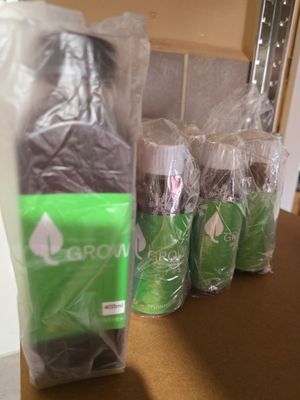
Seedling and leaf nutrient from one bottle, with calcium and magnesium, made for soft water. For all plants from sowing to the growth phase, leafy plants until harvest.
View in the shop ›And the air stone?
The pump runs in intervals, the air stone does not. It does not go on the timer but straight into the socket. That way it runs continuously.
The reason: roots do not photosynthesise. They take their oxygen from the water and breathe around the clock, including at night. If the air stone only runs with the light, there is no supply at night, and the oxygen in the water runs short. The warmer the water, the less oxygen it can hold.
| Where | Air pump | Why |
|---|---|---|
| Seedling station | continuously, day and night | the roots hang in standing water |
| HydroFlex Tower indoors | can, does not have to, useful from the start | the trickling water picks up air |
| outdoors from 25 °C water temperature | must | warm water holds less oxygen |
| Tomato tower | always, each container its own | the roots hang directly in the nutrient solution |
An air stone in the tank is useful from the start. Without it the water stands still between pump cycles, and the roots get less oxygen. It is not expensive: a small 3 watt air pump uses around 2.2 kWh a month. At 30 cents per kWh that is about 65 cents.
How often does the water run in other systems?
The hydro tower is not the only system. Depending on how the roots are supplied with water, the rhythm looks completely different. You will find an overview of the systems in my guide to hydroponics.
Related:The most common hydroponic systems compared›NFT system (Nutrient Film Technique): usually constant
In an NFT system the water flows almost continuously. The nutrient solution constantly moves through the flat, sloping channels in which the roots hang. This ensures a constant supply of nutrients and oxygen, which is crucial for the fast growth of plants in this system.
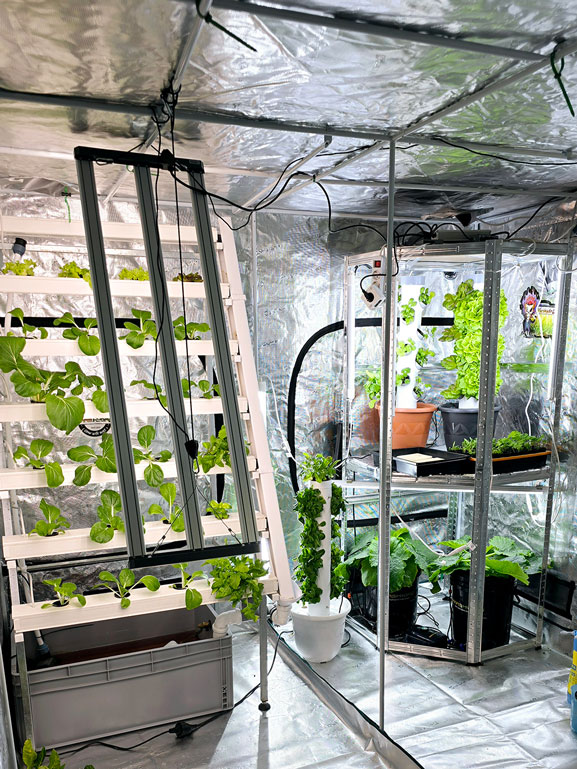
In the NFT system the roots hang in flat, slightly sloping channels. A thin film of nutrient solution flows through the channels. In commercial growing this film usually runs constantly, because the channels hold hardly any water. If the pump fails, the plants wilt quickly there.
In my NFT system, due to its design, some residual water stays in the channels when the water stops, so intervals are possible here too. If the water drains away completely, a continuous flow is required. On hot days the water should generally run continuously to supply the plants optimally, and at night watering can be done in intervals again.
In my own NFT system some water stays in the channels during a break. That is why intervals work there too. If your channels drain completely during a break, the water must flow continuously. On hot days I generally let it run through. You can read more on the page about the Nutrient Film Technique (NFT).
Kratky method and Deep Water Culture (DWC): without a pump
Without any electricity
The Kratky method requires no water pump or continuous water flow. Instead, the plant roots stand in a static container of nutrient solution that is used up by the plants over time.
With air stone
The DWC variant uses an air pump or air stone to supply the water with oxygen. It runs continuously, day and night.
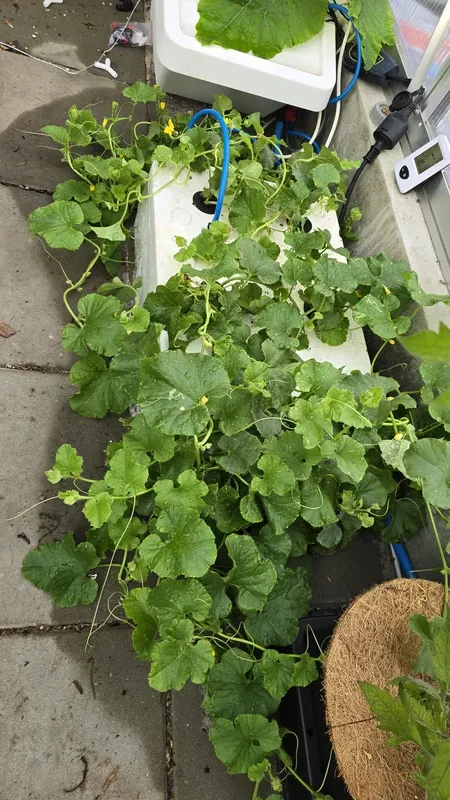
With the Kratky method the roots stand in a container of nutrient solution. There is no pump and no electricity. The plants slowly drink down the water level. Above it an air space forms, from which the upper roots get oxygen. In the DWC variant an air stone also provides oxygen in the water, and it runs continuously. More on this under the Kratky method.

* Affiliate-Link: Bei einem Kauf erhalte ich eine Provision, dein Preis bleibt gleich. Preis inkl. MwSt., zzgl. Versand, Stand 7.11.2026. Bilder: Amazon Creators API

* Affiliate-Link: Bei einem Kauf erhalte ich eine Provision, dein Preis bleibt gleich. Preis inkl. MwSt., zzgl. Versand, Stand 8.11.2026. Bilder: Amazon Creators API
* Affiliate links (Amazon): if you buy, I receive a commission; your price stays the same.
Tomato tower: the pump only helps at the start
In the single-level HydroFlex Tower Largo Uno the tomato roots hang directly in the nutrient solution. You only need a pump there at the start, until the roots reach the water at the bottom. Mine keeps running anyway, so the upper roots are flushed too. Much more important, though, is the air stone: it must always run, and each container has its own.
📖How I use the pump and air stone in the tomato tower is in my book in the chapter “Pumpe und Luftsprudler” (Pump and air stone) for tomatoes. Just check the table of contents.›| System | Pump | Air pump |
|---|---|---|
| HydroFlex Tower indoors | 5 on, 30 off | useful, continuously |
| HydroFlex Tower outdoors in heat | 15 on, 15 off | a must from 25 °C water |
| NFT system | usually constant, intervals only with residual water | not needed |
| Kratky | none | none |
| DWC | none | constantly |
| Tomato tower Largo Uno | needed at the start, mine keeps running | always |
If the pump fails
Short failures do the plants no harm; the roots stay moist for a while. In heat, however, things get tight quickly: if the water is missing for 6 hours in heat, the leaves droop badly. No panic. Then let the water run continuously, and most plants recover. If you have no spare pump, park the plants in the propagation station in the meantime.
So take a quick look at the tower every day. Then you notice a failure before it is too late. I have also built myself an alarm: if the power fails or a pump stops, my phone alerts me immediately. That way I am relaxed even on holiday.
📖How I go on holiday with peace of mind thanks to an alarm and a barrel with automatic top-up is in my book in the chapter “Urlaub ohne Sorgen” (Holidays without worries). Just check the table of contents.›
* Affiliate-Link: Bei einem Kauf erhalte ich eine Provision, dein Preis bleibt gleich. Preis inkl. MwSt., zzgl. Versand, Stand 8.11.2026. Bilder: Amazon Creators API
* Affiliate links (Amazon): if you buy, I receive a commission; your price stays the same.
Roots show you whether everything is right
Look into the tower now and then. Healthy roots are white or pale and strong. If they turn brown, slimy and smell foul, that is root rot. Usually warm or standing water lacking oxygen is behind it. An air stone in the tank prevents it.
Frequently asked questions about watering in hydroponics
How long does the pump run in the hydro tower indoors?
Why do I not set 15 minutes on and 15 minutes off indoors?
Which pump time do I use outdoors in great heat?
When do I let the pump run continuously?
How do I know the break is too long?
Which timer do I need for 5 minutes on and 30 minutes off?
Why is a mechanical timer from the DIY store not suitable?
Why are Wi-Fi plugs with few switching times unsuitable?
Does the air pump also go on the timer?
Why does the air stone also have to run at night?
Do I need an air stone in the HydroFlex Tower indoors?
From what water temperature is the air stone a must?
How long does the air stone run in the propagation station?
How much electricity does a small air pump use?
Which pump time applies to plants from soil?
Do plants started hydroponically need longer pump times at first?
How often does the water run in an NFT system?
Does the Kratky method need a pump?
What is the difference between Kratky and DWC?
How long does the pump run in the tomato tower?
What do I do if the pump has failed in heat?
How do I notice a pump failure in time?
How do I recognise healthy roots?
What helps if the water tank heats up in the sun?
Does the pump in the hydro tower always have to run 15 minutes on and 15 minutes off?
Can I use a mechanical timer?
Does the pump run differently at night than during the day?
How often do I need to change the nutrient solution in the tower?
Is my tap water soft or hard?
Does a DWC system need a water pump?
You will find more basics in my guide to hydroponics, on NFT, on Kratky method, on the right water temperature and in the article The most common hydroponic systems.
Continue with your own growing

168 pages, simply explained for beginners and with videos on the topics (in German). Exactly how I grow myself: from sowing to harvest.
More about the book ›A few questions about space, location and what you want to harvest, and you get a recommendation.
To the tower advisor ›Questions about your setup? Message me on WhatsApp.
Tapping opens WhatsApp (provider: WhatsApp Ireland Ltd.). More in the privacy policy.