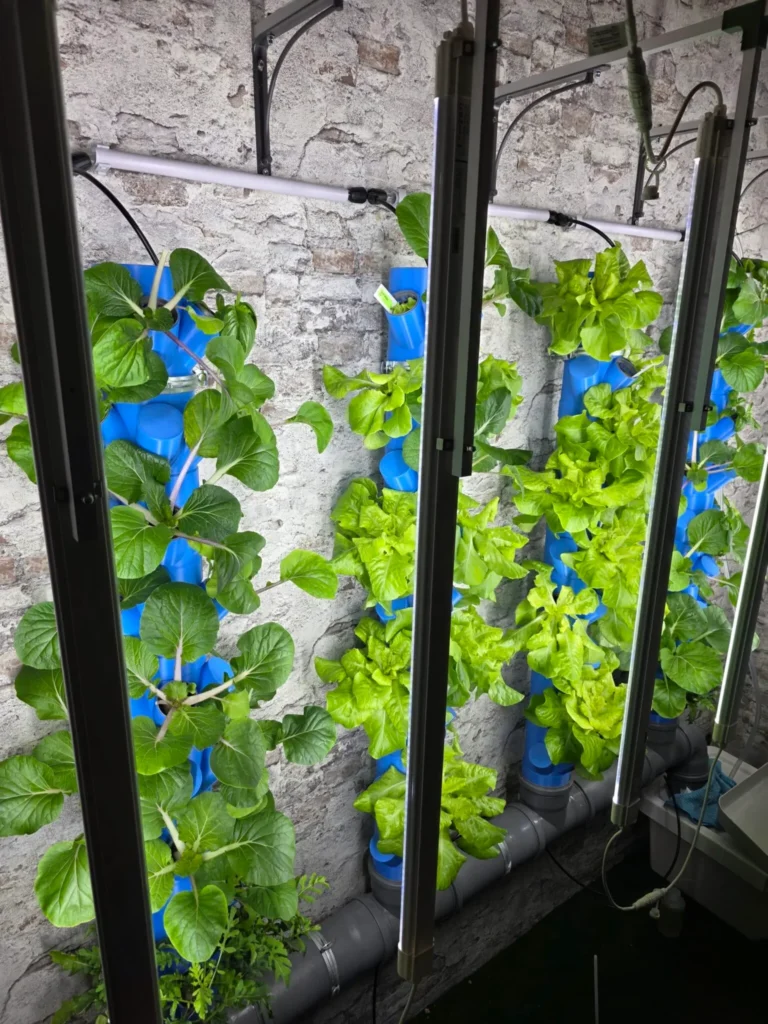
Nutrient Film Technique (NFT): the channel system simply explained
How NFT works, what slope and flow rate the channels need, which values suit lettuce and herbs, and how NFT compares with my HydroFlex Tower.
The efficient hydroponic system for continuous plant growing. Space-saving, low on water and ideal for beginners and professionals!
🌊What is the Nutrient Film Technique (NFT)?
The NFT system is a hydroponic growing system in which the plant roots hang in a thin film of nutrient solution that flows continuously through slightly sloping channels. A pump provides constant circulation so the roots get an optimal supply of water, nutrients and oxygen.
NFT stands for Nutrient Film Technique. The plants sit in holes in a flat channel. A very thin film of nutrient solution flows through this channel, hardly more than a few millimetres. The roots lie at the bottom in the film and take up water and nutrients. The upper part of the roots hangs in moist air and gets its oxygen there.
The method was developed by Allen Cooper in the mid-1960s at the Glasshouse Crops Research Institute in England. Today NFT is one of the most important systems for lettuce in commercial horticulture worldwide. It is a closed loop: the nutrient solution runs from the channel back into the tank and is pumped up again.
⚡ Key features
Horizontal channels
Nutrient film
Continuous supply
- Tank: This is where the nutrient solution is, with the pump in it.
- Inlet: The pump pushes the solution to the upper end of each channel.
- Channel: slightly sloping, light-tight, with holes for the pots.
- Nutrient film: flows thinly along the bottom of the channel past the roots.
- Return: At the lower end everything runs back into the tank.
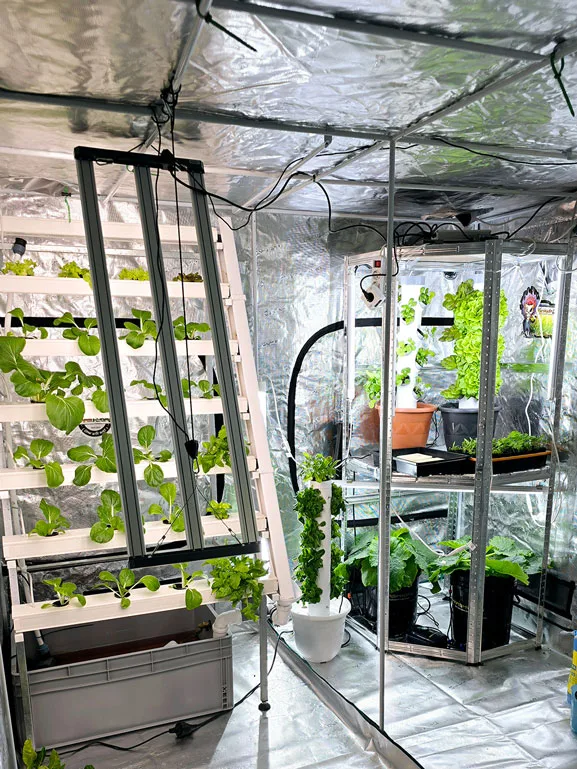
Setting up an NFT channel: slope, flow rate, channel length
The three adjustments: slope, flow rate, channel length
For the film to flow evenly, the channel must be sloped. The specialist literature gives a slope of 1 in 100 as a guideline, that is 1 cm per metre. In practice people often build a little steeper, 1 in 40 to 1 in 30, because no channel is perfectly straight. If water stands in a dip anywhere, the roots there lack oxygen. If it is much too steep, the water rushes through and does not reach all roots equally well.
For flow rate, about 1 litre per minute per channel is considered a good value, 2 litres per minute the upper limit. For freshly planted young plants half is enough. More water does not mean more growth; it just backs up at the roots.
The length of the channel matters too. On the way down the plants use up nutrients and oxygen, and the solution warms up. The last plants then get less. In commercial growing 10 to 15 metres is considered the upper limit. At home, channels of about 1 to 4 metres are usual.
| Adjustment | Guideline | Why |
|---|---|---|
| Slope | 1 in 100 as a guideline, in practice often 1 in 40 to 1 in 30 | The film should flow evenly, without puddles |
| Flow rate | about 1 litre per minute per channel, at most 2 | for young plants half is enough |
| Channel length | at home about 1 to 4 m, in commercial growing at most 10 to 15 m | Otherwise nutrients and oxygen run short at the end of the channel |
| Channel width | often about 10 cm, 4 to 5 cm deep | enough room for the root mat |
| Lettuce spacing | about 15 to 20 cm | The heads must not shade each other |
Tips & tricks for the best results
Efficient nutrient uptake
Space-saving
Low water use
Low risk of overwatering
Easy monitoring
The pump is the heart, and the risk
In classic NFT the pump runs without a break, day and night. The film is so thin that it forms no reserve. If the pump stops, the roots are dry after a short time. The plants then wilt very quickly, on warm days sometimes after a short time. That is NFT’s biggest weakness, and the specialist literature therefore clearly recommends a spare pump.
That is exactly why I always keep a small spare pump for my own systems. For quiet holiday days I have also built myself an alarm: if the power fails or a pump stops, my phone alerts me immediately. I can only recommend that for any system, and for NFT in particular.
 EXLECO Aquariumpumpe 600L/H 8W Tauchpumpen MiniPump with 600 L/h and 8 watts. My pump, also ideal as the spare that always sits in the cupboard.17,99 EURView on Amazon*To Amazon*
 Decdeal 4.8W USB Tauchpumpe AquariumpumpeSmall USB pump for emergencies if the main pump fails.18,99 EURView on Amazon*To Amazon*
* Affiliate link: if you buy through it, I earn a small commission. Your price stays the same. Prices incl. VAT, as of 9.11.2026.
* Affiliate links: I earn a commission if you buy, your price stays the same.
📖How long the pump runs and when the air stone comes in, I explain in my book in the chapter “Pumpe und Luftsprudler” (Pump and air stone). Just check the table of contents.›Suitable plants for the NFT system
NFT is made for fast-growing plants with small roots. The pH and EC values come from my book; the EC applies from growth to harvest (in mS/cm).
| Plant | Suitability | pH | EC growth to harvest |
|---|---|---|---|
| Lettuce (the classic) | Very good | 5.5 to 6.5 | 1.2 to 1.6 (I run 1.1 to 1.2) |
| Basil | Very good | 5.5 to 6.5 | 1.2 to 1.6 |
| Mint | Very good | 5.5 to 6.5 | 1.2 to 1.6 |
| Coriander | Very good | 5.5 to 6.5 | 1.4 to 1.8 |
| Parsley | Very good | 5.5 to 6.0 | 1.2 to 1.6 |
| Spinach | Very good | 6.0 to 6.5 | 1.7 to 2.3 |
| Chard | Very good | 5.5 to 6.5 | 1.7 to 2.3 |
| Rocket | Very good | 5.5 to 6.5 | 0.9 to 1.2 |
| Pak choi | Good | 5.5 to 6.5 | 1.4 to 1.8 |
| Strawberries | Good | 5.5 to 6.5 | 1.1 to 1.4 |
| Peppers | Possible | 5.5 to 6.0 | 1.5 to 2.0 |
| Chillies | Possible | 5.5 to 6.5 | 2.3 to 3.0 |
| Tomato, cucumber | Rarely | see table in the book | Roots and plants get too big |
Many other herbs and leafy greens also work excellently.
📖More on this in my book (in German) in the chapter “pH und EC für alle Pflanzen”. Just check the table of contents.›A few questions about space, location and what you want to harvest, and you get a recommendation.
To the tower advisor ›NFT and HydroFlex Tower in a fair comparison
Both systems are closed loops: a pump brings the nutrient solution to the roots, and the water runs back into the tank. The difference lies in the direction and the rhythm. In NFT the film flows horizontally through sloping channels, and the pump runs non-stop. In my HydroFlex Tower the pump pushes the solution up a riser pipe to the very top, from where it trickles down through the segments and past all the roots.
Some people also call such towers vertical NFT. I see it as a principle of its own, because in the tower the water trickles down through the roots from above instead of flowing as a thin film along the bottom of a channel. That is why my pump can take breaks. Cubes and roots stay moist in between, and the trickling water picks up air as it falls. Indoors I set 5 minutes on and 30 minutes off, outdoors in great heat 15 minutes on and 15 minutes off.
| NFT (channels) | HydroFlex Tower (vertical) | |
|---|---|---|
| Structure | horizontal channels with slope | segments stacked, tank at the bottom |
| Water path | thin film flows through the channel | water trickles from above through the roots |
| Pump | runs constantly | in intervals, indoors 5 on, 30 off |
| If the pump fails | roots are dry quickly | roots stay moist for a while, but in heat the leaves droop quickly too |
| Space | needs table or shelf space | many plants on a small footprint |
| Adjusting | slope and flow rate per channel | pump and timer, no slope |
| Light indoors | lamp above, all plants at one height | lamp at the side, 20 to 30 cm distance |
| Strengths | standard for lettuce in commercial growing, roots easy to reach | compact, for windowsill, balcony and patio |
| Ideal for | Lettuce, herbs, leafy greens | Lettuce, herbs, strawberries, peppers; tomatoes in the Largo Uno |
To be honest: for large lettuce operations with long tables, NFT is a very good choice. At home, where space is tight and you do not want to align every channel individually, the tower is the simpler solution for me. My pepper tower, for example, had 15 segments with 45 plants on the footprint of one container. You can read how to build a tower in my hydro tower guide.
Related:Comparison: the most common hydroponic systems at a glance›Instead of long channels, my plants stand one above the other. The pump runs in intervals, and the water trickles down past the roots from above. For the windowsill there are narrow towers; for tomatoes, cucumbers and peas there is the wide HydroFlex Tower Largo Uno.
View towers in the shop ›NFT system: DIY or buy?
DIY projects
- ✓Low cost
- ✓Flexible to adapt
- ✓Ideal for tinkerers
Ready-made products
- ✓Ready to go quickly
- ✓Little effort
- ✓Ideal for beginners
If you build it yourself, watch out for three things: light-tight, light-coloured channels, an even slope without dips and a spare pump in the cupboard. I do not have an NFT channel system in the shop. If you want to start quickly at home, a ready-made HydroFlex Tower is a good choice, and if you like tinkering, you will find instructions to build your own.
HydroFlex Tower for indoors and outdoors, seedling box, seedling station, support rings and my own nutrient. After you buy, I’ll help you on WhatsApp.
To the shop ›Tips for care & maintenance
Measure pH and EC regularly
Clean channels and pump
Top up the nutrient solution
Light
I show you exactly what that looks like day to day in five steps: from starting seedlings and nutrient solution to cleaning.
1Starting young plants
Cube · propagation station · roots out
Whether NFT or tower: I always start my plants in foam cubes, in my Seedling box with 25 cubes. Then they go into net pots in the Seedling station for 35 plants. There the roots hang in standing water, which is why the air stone in the station runs continuously, at night too. That is the DWC principle.
This step is especially important for NFT. The film in the channel is only a few millimetres high. So the roots must already stick out of the bottom of the pot to reach the film. From about 5 cm in size and with strong roots, my plants move.
2Mix the nutrient solution
always EC first, then pH
For the nutrient solution there is no difference between NFT and tower. Until flowering I use my own Frankie’s liquid nutrient. It contains calcium and magnesium and is made for soft water. Lettuce and herbs stay on it until harvest, because we harvest the leaves.
Always set the EC first and then the pH. My fertiliser lowers the pH, and the more fertiliser in the water, the more it does. For lettuce, EC 1.6 is the maximum. My water is soft, and my lettuces do just as well at 1.1 to 1.2. My pH target is 5.8. More on this on my pages about EC value and the pH value.
 BudgetPious 5-in-1 meterAffordable, easy to use and perfectly adequate for beginners.39,99 EURView on Amazon*To Amazon*
 ProBluelab OnePenShows right after mixing whether the EC suits the growth stage. Every reading is saved in the app for comparison. Pro meter: the app analyses your readings and keeps measurement logs.239,00 EURView on Amazon*To Amazon*
 Pro, in the tankBluelab Guardian MonitorFor everyone who grows a lot: measures around the clock and warns via app when it is time to feed.399,00 EURView on Amazon*To Amazon*
* Affiliate link: if you buy through it, I earn a small commission. Your price stays the same. Prices incl. VAT, as of 9.11.2026.
3Measure and top up
every 2 to 3 days · top up instead of changing
Without a continuous monitor, measure every 2 to 3 days, always EC first, then pH. Plants take up more water than fertiliser. When the water level in the tank drops, the EC therefore rises. In NFT the tank is often the only reserve in the whole system, so a large container is worthwhile here. The more water, the more slowly the values change.
In a running system I do not change the water by the calendar. I top up with ready-mixed nutrient solution, prepared in the watering can. Then I measure: EC too low, add a little fertiliser. EC too high, plain tap water. Finally I check the pH. I change it completely when deficiencies appear even though pH and water temperature are right, or when the EC rises for no reason. Because the meter only shows how much salt is in the water, not which.
 UIUZMAR pH EC TDS Messgerät 7 in 1 pH WertsContinuous monitor for pH, EC and temperature. Stays in the tank, you can see the values at any time.52,34 EURView on Amazon*To Amazon*
 Intervalltimer(1s-999h) Zeitrelais-SteckdoseDigital timer with interval function, for the lamp and for the pump in the tower.14,99 EURView on Amazon*To Amazon*
* Affiliate link: if you buy through it, I earn a small commission. Your price stays the same. Prices incl. VAT, as of 8.11.2026.
* Affiliate links: I earn a commission if you buy, your price stays the same.
4Water temperature and oxygen
ideal 18 to 22 °C
Roots breathe around the clock. Warm water holds less oxygen. With NFT there is the added factor that the flat channels hold only a little water and heat up quickly. So keep the nutrient solution cool and the channels out of direct sun.
| Water temperature | What happens |
|---|---|
| below 18 °C | The roots work more slowly, the plant grows slowly even if EC and pH are right. |
| 18 to 22 °C | Ideal. Nutrient uptake is stable, the water holds enough oxygen. Up to 24 °C is still OK. |
| from 25 °C | Oxygen gets scarce, root rot can develop faster. |
Outdoors, from a water temperature of 25 °C, I put an air stone in the tank, day and night. It does not go on the timer but straight into the socket. A small 3 watt air pump costs only about 65 cents a month at 30 cents per kWh.
 AquaForte – Hi-Flow V-30 Luftpumpe Alu 25WPowerful air pump for a large tank or several containers.51,94 EURView on Amazon*To Amazon*
* Affiliate link: if you buy through it, I earn a small commission. Your price stays the same. Prices incl. VAT, as of 9.11.2026.
* Affiliate links: I earn a commission if you buy, your price stays the same.
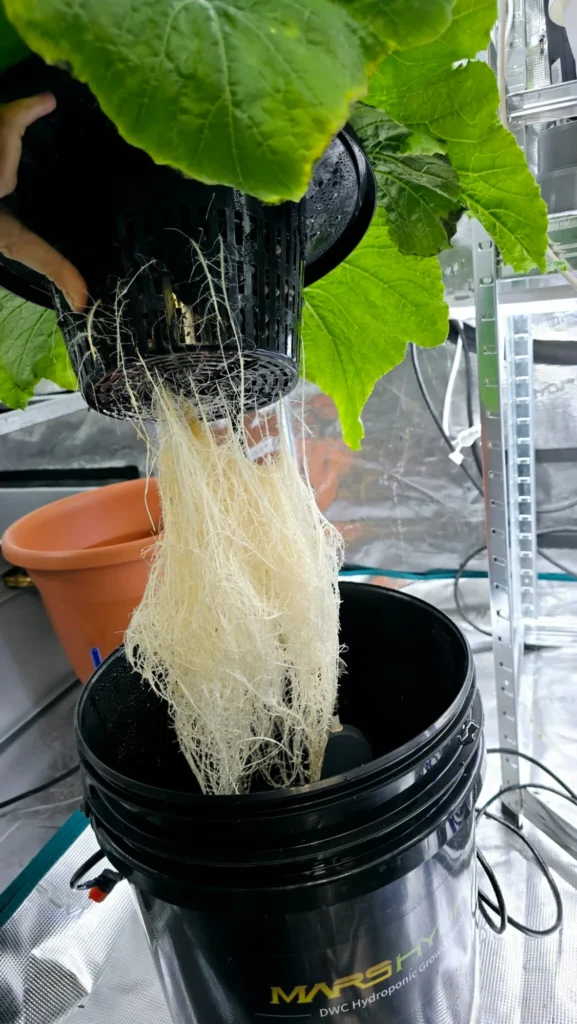
5Light, algae and cleanliness
Lid closed · channels sealed · lamp max. 16 h
Algae need light. If no light falls on the nutrient solution, they have no chance. For NFT that means: channels and tank must be light-tight, and the holes fit snugly around the pots. My container is closed and hardly any light gets in, which is why I have no algae even above 30 °C. A little green on top of the cube is harmless.
Indoors, lettuce and herbs need a grow light, especially in autumn and winter. With NFT it hangs above the channels; with the tower at the side at a distance of 20 to 30 cm. Let it shine for at most 16 hours a day. More on this on my page about lighting.
 MARS HYDRO VG40 LED Pflanzenlampe 60cm IP65LED grow light in a twin pack, good for lettuce and herbs indoors.59,99 EURView on Amazon*To Amazon*
* Affiliate link: if you buy through it, I earn a small commission. Your price stays the same. Prices incl. VAT, as of 9.11.2026.
Lamps and accessories are also available at Grow-Shop24*.
* Affiliate link: I earn a commission if you buy, your price stays the same.
After each round, clean the channels, tank and pump. I put the pump, air stone and hoses in water with a little citric acid for a few hours; that dissolves the limescale. Because all the plants share the same water, a root disease can spread quickly through the loop. Clean parts and cool water are therefore the best precaution.
Common problems and what helps
The plants suddenly wilt
Check the pump first. With NFT a failure is the most common cause, because the thin film has no reserve. Once water flows again, most plants recover. Always keep a spare pump ready.
The plants at the end of the channel grow worse
Then the channel is too long or the flow rate too low. On the way down the solution gets warmer and poorer in oxygen and nutrients. Shorter channels or a second inlet help.
Water stands in the channel
The slope is wrong, or the channel sags. Standing water robs the roots of oxygen. Realign the channel and support it more often.
Brown, slimy roots
Healthy roots are white or pale and strong. If they turn brown, slimy and smell foul, that is root rot. Usually the water is too warm or standing. Clean the system, mix fresh nutrient solution and cool the water.
Pale or yellow leaves
Measure the EC first. If it is too low, nutrients are missing. Then check the pH: if it is off, the plant cannot take up the nutrients even though they are in the water. More on this under nutrients in hydroponics.
Benefits of growing without soil
Fewer pests
Clean
Controlled nutrient supply
Faster growth
It still does not work entirely without care: because all the plants share the same water, clean channels and cool water keep root diseases away.
Conclusion
The NFT system is one of the most efficient methods of hydroponic growing. It combines a space-saving design with an optimal nutrient supply and is suitable for beginners and advanced growers alike.
With a little care and the right tips, your start is sure to succeed!
My advice: pay attention to slope, flow rate and a spare pump, set the EC first and then the pH, keep the water at 18 to 22 °C and top up instead of changing by the calendar. If you want to harvest a lot from a small area at home, the tower is often the simpler route.
Further reading
More systems without soil: the simplest one, with no pump at all, is the Kratky method. You will find all the basics step by step under Hydroponics for beginners and in the lettuce guide.


Frequently asked questions about the NFT method
Frequently asked questions about the Nutrient Film Technique, answered briefly: tap a question and the answer opens.
What does NFT mean in hydroponics?
Who developed the Nutrient Film Technique?
How do the roots get oxygen in an NFT system?
What slope does an NFT channel need?
How much water should flow through an NFT channel?
How long can an NFT channel be?
Does the pump run continuously in NFT?
What happens if the pump fails in NFT?
What is the difference between NFT and a hydro tower?
How long does the pump run in the HydroFlex Tower?
Why can the pump take breaks in the tower but not in NFT?
Which plants are best suited to NFT?
What EC value do I use for lettuce in an NFT system?
What pH value is right in an NFT system?
Do I need special fertiliser?
Which water temperature is ideal?
Why do NFT channels heat up quickly?
How often do I need to measure EC and pH?
How often do I need to change the nutrient solution?
Why does the EC rise when the water level drops?
How do I prevent algae in an NFT system?
When do I put young plants into the NFT channel?
Why does an air stone run in the propagation station?
Why do plants at the end of the channel grow worse?
Build an NFT system yourself or buy one?
Is NFT or the hydro tower better for home?
Continue with your own growing

168 pages, simply explained for beginners and with videos on the topics (in German). Exactly how I grow myself: from sowing to harvest.
More about the book ›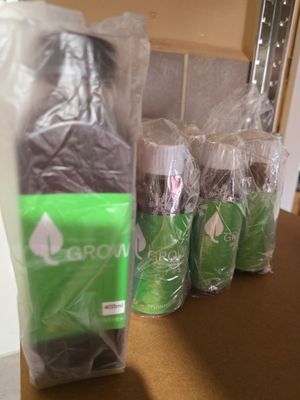
Seedling and leaf nutrient from one bottle, with calcium and magnesium, made for soft water. For all plants from sowing to the growth phase, leafy plants until harvest.
View in the shop ›Questions about your setup? Message me on WhatsApp.
Tapping opens WhatsApp (provider: WhatsApp Ireland Ltd.). More in the privacy policy.