Growing basil in a hydro tower: from seed to harvest
I’ll take you step by step: germination, seedlings, moving into the tower, the right cut and light indoors. With the right water values from my book.
🎯
pH 5.5 to 6.5
I set it to 5.8
⚡
EC 0.4 to 1.6
rises step by step with the plant
🌡️
20 to 25 °C
for germination, basil needs light to germinate
💡
200 to 300 PPFD
light indoors, 14 to 16 hrs
Why basil does so well in the tower
Basil is one of the herbs that’s real fun in the tower. With enough warmth and light it grows quickly, smells strong and can be harvested again and again for weeks. It shows problems early and clearly, so you quickly learn what matters. In the tower the roots always have water and air, you don’t water by feel, you measure.
Basil profile
What
Value
Germination
light germinator, 20 to 25 °C, usually 5 to 14 days
Seeds per cube
one
pH value
5.5 to 6.5, my target 5.8
EC value (mS/cm)
seedlings 0.4, young plant 0.8, growth 1.2, harvest 1.6
Nutrient solution
18 to 24 °C
Pump
indoors 5 on / 30 off, outdoors in heat 15 on / 15 off
Light indoors
young plants 100 to 150 PPFD, then 200 to 300 PPFD, 14 to 16 hours
Harvest
cut whole shoot tips above a pair of leaves
The seed packet comes first
Germination time and temperature vary by variety. If your packet says something different from my table, go by the packet.
I don’t start basil directly in the tower. I start in moist foam cubes in the seedling box. When the seedlings stand stable and the first roots show, the cube goes into a 5 cm net pot and into the seedling station. There I have moisture, water level, temperature and light much better under control in the sensitive start phase.
Here you can see the process with foam cube, seedling box and seedling station again in practice (in German).
The video only loads from YouTube after you tap (youtube-nocookie.com).
1Germination
one seed per cube · light germinator · no nutrient yet
One basil seed goes into each moist foam cube. Basil should later grow as a single, strong plant, so one is enough. I only set the seed lightly into the slit of the cube. It should stay there and keep evenly moist, but not sink in deep.
Basil needs light to germinate. So you don’t cover it. The lid of the seedling box holds the moisture but lets light through. 20 to 25 °C is ideal. The cube stays moist but mustn’t drip when pressed lightly. Check daily and moisten carefully from above if needed. In this phase there’s only water.
Germination temperature
20 to 25 °C
Germination type
Light germinator
Germination time
usually 5 to 14 days
Nutrient
none yet
1. Prepare sowing: box, moist cubes and seed ready.2. Place the small seeds individually, one per cube.3. Later the seedlings move into the seedling station.
How I keep the germination temperature stableIn a cool room the heat mat only helps during germination.
That’s one option, not a must. If your room is already at 20 to 25 °C, you don’t need a heat mat. If it’s cooler, I keep the germination zone warm with it. As soon as the seedlings are up, I switch off the heat mat. After that they keep growing under the lamp at about 20 to 22 °C, because too much warmth with little light makes long, thin stems.
Heat mat with thermostat for germination if your room is too cool.
* Affiliate-Link: Bei einem Kauf erhalte ich eine Provision, dein Preis bleibt gleich. Preis inkl. MwSt., zzgl. Versand, Stand 8.11.2026. Bilder: Amazon Creators API
Genovese basil seeds, the classic variety for beginners. Also follow the information on your seed packet.
* Affiliate-Link: Bei einem Kauf erhalte ich eine Provision, dein Preis bleibt gleich. Preis inkl. MwSt., zzgl. Versand, Stand 8.11.2026. Bilder: Amazon Creators API
Plant labels with pen, so variety and sowing date stay clear from day one.
* Affiliate-Link: Bei einem Kauf erhalte ich eine Provision, dein Preis bleibt gleich. Preis inkl. MwSt., zzgl. Versand, Stand 8.11.2026. Bilder: Amazon Creators API
2Seedlings
after emergence · EC 0.4 to 0.8
As soon as the seedling is visible, I add my liquid nutrient and increase it with each development step. The millilitres are only the starting value. What matters is the EC of the finished solution, because every tap water already brings its own EC. Always set the EC first, then the pH.
Phase
Frankie’s liquid nutrient (starting value)
EC target
Germination
0 ml per litre
water only
after emergence
0.5 ml per litre
about 0.4
first true leaves, young plant
1 ml per litre
about 0.8
Growth in the tower
2 ml per litre
about 1.2
big plants, harvest
up to 3 ml per litre
up to 1.6
Water level in seedling box and seedling station
In the seedling box the water stands at about a third of the cube height. The cube draws the moisture up, seed and stem never stand in water permanently. In the seedling station the cube can stand about 0.5 cm in water at first. Once several roots reach safely into the solution, lower the water level. Then 0.5 to 1 cm of air gap remains between net pot and water so the roots get air. In the seedling station I change the solution about once a week.
pH
5.5 to 6.5, target 5.8
EC
0.4 to 0.8
Air gap
0.5 to 1 cm
Change in station
1× per week
Young basil shortly before it moves into the tower.
Practical tip in the video: water level and air gap
Here I show you when the cube may still touch water and when an air gap should remain (in German).
The video only loads from YouTube after you tap (youtube-nocookie.com).
Bluelab OnePen for pH, EC and temperature, if you measure often and want it more convenient.
* Affiliate-Link: Bei einem Kauf erhalte ich eine Provision, dein Preis bleibt gleich. Preis inkl. MwSt., zzgl. Versand, Stand 8.11.2026. Bilder: Amazon Creators API
Permanent monitor for pH, EC and temperature. Stays in the reservoir, you see changes immediately.
* Affiliate-Link: Bei einem Kauf erhalte ich eine Provision, dein Preis bleibt gleich. Preis inkl. MwSt., zzgl. Versand, Stand 8.11.2026. Bilder: Amazon Creators API
Calibration solution for pH 4 and 7, so your meter measures correctly.
* Affiliate-Link: Bei einem Kauf erhalte ich eine Provision, dein Preis bleibt gleich. Preis inkl. MwSt., zzgl. Versand, Stand 8.11.2026. Bilder: Amazon Creators API
3Growth in the tower
move with strong roots · EC 0.8 to 1.2
Basil moves into the tower when it has several true leaves, a stable stem and strong roots outside the cube. After planting, check immediately whether water reaches every occupied opening.
There’s no fixed number of plants per segment. Basil gets wide and tall. Spread it so the big plants don’t touch or shade each other permanently. Close free openings with cover caps. Basil combines well with lettuce if the lettuce gets enough light.
pH
5.5 to 6.5, target 5.8
EC young plant
about 0.8
EC growth
about 1.2
Nutrient solution
18 to 24 °C
Pump timing and air pump
Indoors my pump runs for 5 minutes and then pauses for 30 minutes. Outdoors in blazing sun and heat I set 15 minutes on and 15 minutes off. If the leaves droop, the pause is too long. The easiest way is a digital timer with a cycle function. The air pump doesn’t go on the timer, it runs constantly for me and brings oxygen to the roots.
Pump indoors
5 on / 30 off
Pump outdoors in heat
15 on / 15 off
Air pump
runs constantly
Top up instead of constantly changing
In a running tower I don’t change the water constantly. I top up with ready-mixed nutrient solution in the target range, measure and balance: if the EC is too low, a little nutrient goes in, if it’s too high, plain water. I mix completely fresh if the EC rises for no reason, the solution smells or the plants show deficiency.
Digital timer with cycle function. I set 5 minutes on and 30 minutes off.
* Affiliate-Link: Bei einem Kauf erhalte ich eine Provision, dein Preis bleibt gleich. Preis inkl. MwSt., zzgl. Versand, Stand 8.11.2026. Bilder: Amazon Creators API
Small submersible pump for the tower. Lift height and hose connection must suit your system.
* Affiliate-Link: Bei einem Kauf erhalte ich eine Provision, dein Preis bleibt gleich. Preis inkl. MwSt., zzgl. Versand, Stand 8.11.2026. Bilder: Amazon Creators API
The air pump I use myself. With many outlets, hoses and air stones.
* Affiliate-Link: Bei einem Kauf erhalte ich eine Provision, dein Preis bleibt gleich. Preis inkl. MwSt., zzgl. Versand, Stand 8.11.2026. Bilder: Amazon Creators API
Air stones that spread the bubbles finely in the water.
* Affiliate-Link: Bei einem Kauf erhalte ich eine Provision, dein Preis bleibt gleich. Preis inkl. MwSt., zzgl. Versand, Stand 8.11.2026. Bilder: Amazon Creators API
pH down and pH up as a set. Only dose in small steps, stir and measure again.
* Affiliate-Link: Bei einem Kauf erhalte ich eine Provision, dein Preis bleibt gleich. Preis inkl. MwSt., zzgl. Versand, Stand 8.11.2026. Bilder: Amazon Creators API
Phosphoric acid as pH down for experienced growers. Caution acid: wear safety glasses and gloves, always add acid to water, never water to acid.
* Affiliate-Link: Bei einem Kauf erhalte ich eine Provision, dein Preis bleibt gleich. Preis inkl. MwSt., zzgl. Versand, Stand 8.11.2026. Bilder: Amazon Creators API
4Harvest and pruning
cut whole shoot tips · EC up to 1.6
If you only pick single big leaves, basil grows tall and hardly branches. That’s why I cut whole shoot tips. Find the spot where two opposite leaves sit and cut the shoot just above this pair of leaves. Two to four strong pairs of leaves stay below.
New side shoots then grow from the leaf axils. That way your basil gets bushy and you can harvest it again and again. I feed big plants with an EC up to about 1.6.
use clean, sharp scissors
don’t squeeze or tear shoots
remove flower buds early
briefly rinse leaves before eating
After cutting above a pair of leaves, basil regrows bushy.
5Light indoors
measure the amount of light at leaf height · 200 to 300 PPFD
As soon as the seedlings emerge, they need light. Watts and lumens say little. I measure the PPFD value directly at the top leaves. Seedlings and young plants get by well with 100 to 150 PPFD. For strong growth basil needs 200 to 300 PPFD.
On the tower my lamps hang at the side, 20 to 30 cm from the plants. From above the light hardly reaches the lower levels. Lamp, dimmer setting and area change the value, so measure at several spots. With a strong lamp 14 hours are enough, leave a weaker one on for 16 hours, but never longer.
Young plants
100 to 150 PPFD
Growth
200 to 300 PPFD
Light duration
14 to 16 hrs
Humidity
55 to 70 %
Gentle air movement
A small fan moves the leaves slightly. That strengthens the stems and lets wet leaves dry faster. But it doesn’t replace air exchange in the room, so still air regularly.
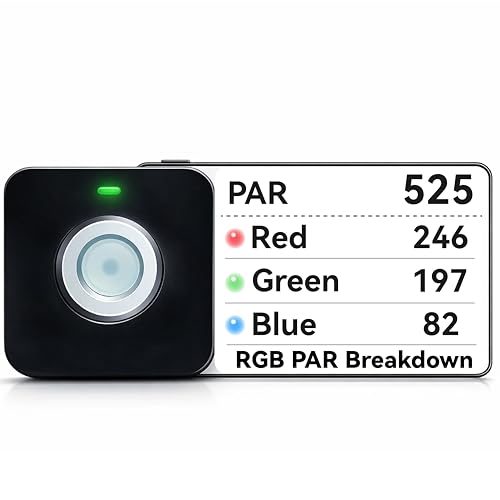
PAR meter. Lets you set lamp and distance by the light that really reaches the leaves.
* Affiliate-Link: Bei einem Kauf erhalte ich eine Provision, dein Preis bleibt gleich. Preis inkl. MwSt., zzgl. Versand, Stand 8.11.2026. Bilder: Amazon Creators API
LED grow light for smaller seedling areas and shelves.
* Affiliate-Link: Bei einem Kauf erhalte ich eine Provision, dein Preis bleibt gleich. Preis inkl. MwSt., zzgl. Versand, Stand 8.11.2026. Bilder: Amazon Creators API
* Affiliate-Link: Bei einem Kauf erhalte ich eine Provision, dein Preis bleibt gleich. Preis inkl. MwSt., zzgl. Versand, Stand 8.11.2026. Bilder: Amazon Creators API
Seedling shelf with light if you want to raise several crops in little space.
* Affiliate-Link: Bei einem Kauf erhalte ich eine Provision, dein Preis bleibt gleich. Preis inkl. MwSt., zzgl. Versand, Stand 8.11.2026. Bilder: Amazon Creators API
Clip fan for gentle air movement between the plants.
* Affiliate-Link: Bei einem Kauf erhalte ich eine Provision, dein Preis bleibt gleich. Preis inkl. MwSt., zzgl. Versand, Stand 8.11.2026. Bilder: Amazon Creators API
Thermometer and hygrometer for temperature and humidity.
* Affiliate-Link: Bei einem Kauf erhalte ich eine Provision, dein Preis bleibt gleich. Preis inkl. MwSt., zzgl. Versand, Stand 8.11.2026. Bilder: Amazon Creators API
Simple thermometer with probe for the nutrient solution temperature.
* Affiliate-Link: Bei einem Kauf erhalte ich eine Provision, dein Preis bleibt gleich. Preis inkl. MwSt., zzgl. Versand, Stand 8.11.2026. Bilder: Amazon Creators API
* Affiliate link: I earn a commission if you buy, your price stays the same. The Amazon boxes on this page are affiliate links.
From my shop
Everything for your soil-free start
HydroFlex Tower for indoors and outdoors, seedling box, seedling station, support rings and my own nutrient. After you buy, I'll help you on WhatsApp.
Which basil is suitable for hydroponics and the hydro tower?
Compact Genovese basil is good for beginners. Sprawling varieties work too, but need more space in the tower and mustn't shade the neighbouring plants permanently.
Is basil suitable for hydroponics beginners?
Yes. With enough warmth and light basil grows quickly and shows problems clearly. A warm germination phase, the right water level, a stable pH and enough light after emergence are important.
Does basil need light to germinate?
Yes. The seed only goes lightly into the slit of the moist foam cube and isn't covered. A transparent lid holds the moisture and still lets light reach the seed.
How many basil seeds go into a foam cube?
I put one seed into each cube. Basil should later grow as a single, strong plant. I only use several seeds per cube for herbs I harvest as a bunch, for example parsley or chives.
What temperature does basil need to germinate?
20 to 25 °C is ideal. After emergence I switch off the heat mat and grow the young plants on at about 20 to 22 °C under enough light.
Why isn't my basil germinating?
Common reasons are too low a temperature, old seed, a dried out or waterlogged cube and seeds sown too deep. Basil needs light to germinate and stays on the surface. In the germination phase there's only water.
How moist does the foam cube have to be?
Evenly moist, but it mustn't drip when pressed lightly. Too much water pushes out the air, drying out completely can end germination. I check daily and only add small amounts of water.
When does basil go into the seedling station?
As soon as the seedling stands stable and the first light roots are visible. Then the cube goes into a 5 cm net pot and into the seedling station. Very small seedlings dry out faster when transplanted.
How high is the water level in seedling box and seedling station?
In the seedling box the water stands at about a third of the cube height. In the seedling station the cube can stand about 0.5 cm in water at first. Once several roots reach safely into the water, 0.5 to 1 cm of air gap remains.
Does basil still need a heat mat after emergence?
Normally not. As soon as the seedlings are up, I switch off the heat mat and put them under the lamp. Lots of warmth with little light quickly makes long, unstable stems.
When is basil ready for the hydro tower?
When the young plant has several true leaves, a stable stem and visible light roots. After planting, check immediately whether water reliably reaches the opening.
When and how much nutrient does basil get?
During germination there's only water. After that I start with my liquid nutrient at 0.5 ml per litre, with the first true leaves 1 ml, in growth 2 ml and for big plants up to 3 ml. What matters is the measured EC: about 0.4 for seedlings, 0.8 as a young plant, 1.2 in growth and up to 1.6 at harvest.
Does basil need grow light in the flat?
Usually yes, especially in autumn and winter. A bright windowsill often doesn't supply light evenly enough. What matters is the PPFD value at leaf height, not the wattage of the lamp.
What does PPFD mean for grow lights?
PPFD describes how much light usable for photosynthesis arrives on an area per second. It's measured directly at the leaves. Young basil plants need about 100 to 150 PPFD, for strong growth 200 to 300 PPFD.
How long does the grow light shine and how far away does it hang?
With a strong lamp 14 hours are enough, a weaker one runs 16 hours, but never longer. On the tower the lamp hangs at the side, 20 to 30 cm from the plants. To check, measure the PPFD value at leaf height.
Why is basil getting long, thin and unstable?
Usually it's lack of light together with too much warmth. Measure the PPFD at the leaves and adjust the distance or power of the lamp step by step. After emergence the heat mat goes away.
Why does basil get yellow or pale leaves?
Possible causes are an unsuitable pH or EC, too little light, cold nutrient solution or damaged roots. Measure pH, EC, water temperature and light first. More nutrient on suspicion often makes it worse.
Why are the basil leaves drooping or curling?
That can be due to heat, too strong light, too high an EC, damaged roots or uneven water supply. Check the water flow and roots first, then temperature, pH, EC and light. If the leaves droop in the tower, the pump pause is often too long.
Why does basil get brown or black leaf spots?
Spots appear for example after cold, from water drops under strong light, mechanical damage or fungi and bacteria. Remove badly damaged leaves, keep the foliage dry and ensure air movement. Check roots and nutrient solution at the same time.
How do I prevent high humidity and fungal problems?
Give the plants enough space, air the room regularly and move the air with a small fan. The leaves should only move slightly. Leaves that are permanently damp and close together dry poorly.
Can basil stand outdoors in the hydro tower?
Yes, as soon as it's reliably warm and frost-free. Cold nights slow basil down a lot. In great heat I set the pump to 15 minutes on and 15 minutes off and protect the reservoir from direct sun.
What do I check first if basil suddenly looks bad?
Don't add more nutrient on suspicion. First check water level, pump and water flow, then water temperature, pH and EC. After that look at roots, leaf undersides, light and air movement and only change one noticeable point.
What does the EC value mean?
The EC shows how well the water conducts electricity. Dissolved salts from tap water and nutrient raise it, so it shows how strong the nutrient solution is overall. It doesn't reveal which individual nutrient is in it. The usual unit is mS/cm.
What does the pH value mean?
The pH shows whether a solution is acidic, neutral or alkaline. It determines how well the roots take up the individual nutrients. For basil the range is 5.5 to 6.5, I set it to 5.8.
Which meters do I need as a beginner?
At least a pH and an EC meter or a good combination meter. A water thermometer makes sense, for indoors a PPFD meter helps. Rinse the probes after measuring and store them as the manufacturer says.
Why do pH and EC meters need calibrating?
Meters drift over time and then show a precise but wrong number. Calibrate regularly with fresh calibration solution as the manufacturer instructs. If the values jump illogically, first check cleaning, calibration and the probe.
Which pH value is right for basil in hydroponics?
The range is 5.5 to 6.5, my target is 5.8. First mix in the nutrient and set the EC, only then measure and correct the pH. Small deviations are no reason to dose again immediately.
What EC value does basil need in the hydro tower?
The EC rises with the plant: about 0.4 for seedlings, 0.8 as a young plant, 1.2 in growth and up to 1.6 for big plants at harvest. No feeding yet in the germination phase.
Can I use normal tap water for basil?
Yes, if you know your water. First measure the EC of the tap water without nutrient and then the finished nutrient solution. Soft water is below 0.3, medium 0.3 to 0.5, hard above.
What does a high EC of the tap water mean?
Then there's less room for nutrient. If your water is already at 0.8 and your target 1.2, only about 0.4 remains for nutrient. The full millilitre amount would then be too much.
What do I do with very hard tap water?
Mix it half and half with rain or RO water and measure again. That roughly halves the hardness. I don't use pure rain or RO water because it barely buffers and the pH then swings more.
Why does the EC rise in a running hydro tower?
The plants take up more water than nutrient salts, and water evaporates. The solution gets stronger as a result. Add plain water, let everything mix and measure again. If the EC keeps rising for no reason, mix a fresh solution.
How often do I change the nutrient solution?
In the seedling station about once a week. In a running tower I top up with ready-mixed nutrient solution instead of constantly changing. I mix completely fresh if the EC rises for no reason, the solution smells or deficiency shows.
Why shouldn't I keep topping up the reservoir with strong nutrient?
Plants don't take up water and nutrients in the same ratio. If you keep topping up with too strong a solution, individual salts build up. That's why I top up with ready-mixed nutrient solution in the target range and then check EC and pH.
What do I set first: EC or pH?
Always EC first. The nutrient also changes the pH, so you'd shift a pH set beforehand. So: water, mix in nutrient, set EC, only then bring the pH to about 5.8.
How do I mix fresh nutrient solution with a 10 litre watering can?
First water goes in, then the calculated amount of liquid nutrient, and everything is mixed well. With my soft water I start a little stronger and then add water until the EC is right. Only then do I set the pH to about 5.8.
How do I measure the EC correctly when mixing?
Rinse the probe and first measure your plain starting water. After adding nutrient, mix thoroughly and measure in the solution, not in the stream of water. If the value is too low, add a little nutrient, if it's too high, dilute with water.
What do I do if I've added too much nutrient?
Don't panic, simply dilute. Add clean water step by step, mix and measure again until the target value is reached. pH down doesn't lower the EC. Check the pH right at the end.
How do I correct the pH without overdosing?
The EC must be set beforehand. Then add only a very small amount of pH down, mix and measure again before adding more. With a badly wrong mix, mixing fresh is safer than many counter-corrections.
How warm may the nutrient solution for basil be?
Ideally 18 to 24 °C. Cold water slows nutrient uptake. Very warm water holds less oxygen and increases the risk of brown roots, above 25 °C it gets critical.
Why does my pH rise again after lowering it?
Often bicarbonate in the tap water buffers the acid. Carbon dioxide gassing out and the plants' nutrient uptake also shift the pH. Lower it in small steps and check again later.
Can I use citric acid to lower the pH?
It does lower the pH, but I don't recommend it for a running tower. The effect often lasts only a few hours because microorganisms break it down. I use a mineral pH down, phosphoric acid in my case.
How do I use phosphoric acid to lower the pH?
With my soft water I start with two drops per 10 litres of finished nutrient solution, mix and measure. If the pH is still above 5.8, at most one more drop goes in. Concentrated acid is dangerous: wear safety glasses and gloves and always add acid to water, never the other way round.
Is phosphoric acid in the nutrient solution harmful to basil?
Not in small, proper amounts and at a suitable pH. Overdosing, too low a pH and too much phosphate are problematic. Careful dosing and measuring are what matter.
How long does the pump run in the hydro tower?
Indoors 5 minutes on and 30 minutes off. Outdoors in great heat 15 minutes on and 15 minutes off. If the leaves droop, the pause is too long.
Roughly how much electricity does the water pump cost?
At 5 minutes on and 30 minutes off the pump runs around 3.4 hours a day. A 5 watt pump uses about 0.5 kWh a month, so at 30 cents per kWh around 15 cents. Measure the real consumption with an energy meter plug.
Why is a spare pump useful?
If the pump fails, the roots in the tower dry out quickly. You fit a matching spare pump immediately. Without a spare, park the plants in the seedling station in the meantime, and always unplug before working on the pump.
When does basil need an air pump?
My air pump always runs and isn't on the timer. It brings oxygen to the roots. That's especially important when the water gets warm, because warm water holds less oxygen.
Why are the roots brown or smell unpleasant?
That indicates root rot, usually from water that's too warm and lack of oxygen. Check water temperature, pump, water flow and air pump. Remove loose root remains and mix fresh nutrient solution if it smells.
What do healthy basil roots look like?
Healthy roots are white or light, firm and smell neutral. If they turn dark, slimy and smell rotten while the plant weakens, you need to act. Then check water temperature, oxygen, pump and water flow.
Why do algae form in the tank or at free openings?
Algae need light, water and nutrients. Keep the reservoir light-proof and close free openings with cover caps. Remove deposits early and clean all parts when mixing fresh.
How do I clean the hydro tower properly?
Remove wilted leaves and loose root remains immediately. When mixing fresh, clean tank, lid, net pots and all reachable parts with lukewarm water and a soft brush. No hot steam on PETG and no harsh cleaners that leave residues.
Can I extend the hydro tower or make it smaller in winter?
Yes. Before extending, check stability, pump lift height and water distribution. In winter you can leave out segments. After every change, check whether water reaches every opening.
Do I have to plant every opening in the hydro tower?
No. Basil gets wide and tall, free spots improve light and air. I close unused openings with cover caps so less light falls into the reservoir.
Can I grow basil with lettuce in the same hydro tower?
Yes, that works well. Both cope with an EC up to about 1.6 and a pH around 5.8. Basil grows taller and mustn't shade the lettuce permanently.
Can I plant young plants and big basil together?
Yes, if the young plants already have strong roots and true leaves. The big ones mustn't take their light. Very fresh seedlings stay in the seedling station for now.
How do I harvest and cut basil correctly?
I cut whole shoot tips just above a pair of leaves. Two to four strong pairs of leaves stay below. Side shoots grow from the leaf axils, the plant gets bushy and you harvest again and again.
How do I stop basil from flowering?
Harvest the shoot tips regularly and remove flower buds early. Lots of warmth and a long growing time encourage flowering. Flowering basil isn't poisonous, but forms fewer tender leaves.
Why is basil getting bare or woody at the bottom?
If only single leaves are plucked and the tip is never cut, it grows tall and branches little. Regular cutting above a pair of leaves encourages side shoots. I replace very old, woody plants with young ones.
Can I propagate basil from cuttings?
Yes. Cut a healthy shoot below a leaf node, remove the lower leaves and put it in clean water. Once enough light roots have formed, put it carefully into a net pot.
Does basil from the hydro tower actually taste good?
Yes, very aromatic. The plant forms its typical scent and flavour compounds without soil too. What matters is variety, enough light, suitable temperature, a balanced nutrient solution and freshly harvested shoot tips.
Does hydroponic basil just taste of water?
No. The flavour sits in essential oils in the leaves, not in the water at the roots. Weak light, an unsuitable variety or a very late harvest can weaken the flavour, not hydroponics itself.
Does hydroponic basil contain vitamins?
Yes. Basil remains a living plant and forms vitamins, pigments and flavour compounds in its metabolism. How high the contents are depends on variety, light, temperature, supply and harvest time.
Which vitamins and minerals does basil contain?
Basil contains vitamin K, carotenoids as a precursor of vitamin A and minerals, among other things. The amounts vary, and a portion of basil is small. It's mainly an aromatic kitchen herb.
Where does basil get its nutrients without soil?
Even in soil the plant only takes up minerals dissolved in water. In the tower they get into the water specifically via the nutrient: nitrogen, phosphorus, potassium, calcium, magnesium and trace elements. On top of that the plant needs light, oxygen and carbon dioxide from the air.
Are nutrients and vitamins the same thing?
No. Nutrients in the nutrient solution are dissolved minerals that the roots take up. The plant forms vitamins itself in its metabolism. So no vitamins go into the tower, but water and minerals.
Does basil take up the nutrient directly into the leaves?
No. The roots take up water and the nutrients dissolved in it, the plant distributes and processes them. Too much nutrient doesn't make the plant more valuable, it stresses the roots. That's why you dose by the measured EC.
Can you taste the hydroponic nutrient in the basil?
Not with a correctly mixed nutrient solution. A bitter or weak taste usually has other reasons, such as flowering, age, heat, little light or a far too strong solution. The nutrient solution belongs at the roots, not on the leaves.
Is hydroponic basil artificial?
No. The plant grows from a seed, forms roots and photosynthesises just like in soil. The only difference is that the roots get their minerals from a controlled nutrient solution instead of from soil water.
Is hydroponics just chemistry?
Hydroponics works with water, light, air and dissolved minerals. The plant takes up the same elements as from soil water. The difference is control: I set nutrient, EC and pH specifically.
Is mineral hydroponic nutrient harmful?
Not when used correctly. It supplies the plant with the necessary elements in dissolved form. Wrong products, heavy overdosing or a wrong pH become harmful. I only use nutrients for hydroponics and edible plants and check with the EC meter.
How do I describe my growing?
Honestly and precisely: without soil, with a controlled nutrient solution and under my own conditions. Instead of buzzwords I'd rather show you what's really in the water and how I work.
Is hydroponic basil less natural?
No. Basil remains a real plant with seeds, roots, leaves and photosynthesis. The tower only changes how water, oxygen and minerals reach the roots.
Do harmful nutrient residues remain in the basil?
The plant takes up dissolved nutrients and incorporates them into its metabolism, that's not a layer of nutrient on the leaf. A suitable nutrient and the right amount are important. The nutrient solution is never sprayed on the leaves.
Is hydroponic basil fit to eat?
Yes, with a suitable nutrient, clean water and well-kept parts. Remove diseased or slimy plant parts and harvest with clean scissors. With mould, a rotten smell or a dirty system, stop harvesting.
Do I have to wash basil from the hydro tower before eating?
Yes, a brief rinse is enough. Home-grown basil can also carry dust, splashes or small insects. Long soaking costs flavour, soap or cleaners don't belong on food.
What does the flavour of basil depend on?
On the variety and its flavour compounds, as well as light, temperature, nutrient supply, age of the plant and harvest time. For strong flavour basil needs enough light and healthy growth that isn't overfed. Regular cutting keeps the plant young.
Does basil from soil generally taste better than from hydroponics?
That can't be said across the board. Poorly supplied basil in soil can taste weak, a well-lit one in the tower very aromatic. For a fair comparison, variety, age, light and harvest time would have to be the same.
What is hydroponics?
In hydroponics basil grows without soil. The roots get water, oxygen and dissolved nutrients directly from the nutrient solution. In the hydro tower the pump pushes the water up, from there it runs past the roots back into the reservoir.
Pests on basil: what I look out for
Basil is sensitive. Look under the leaves once a week, then you'll catch everything early:
🐜
Aphids
On shoot tips and leaf undersides. Rinse off with water.
🕸️
Spider mites
Fine webs and light dots, especially in dry heated air. Rinse the leaves.
🪰
Whitefly
Flies up when touched. Hang up yellow sticky traps.
🍂
Downy mildew
Yellow leaves, grey coating underneath. Ensure air flow, not below 15 °C.
My tip for outdoors
Outdoors a fine insect net over the tower keeps aphids and whitefly away. I use this net:
My conclusion: what does hydroponics cost and is it worth it?
Yes, hydroponics costs money. You need a system, a pump, nutrient, meters and indoors a lamp. If you only compare against the price of a pot of basil in the shop, the bought one is often cheaper. But for me hydroponics is much more: a wonderful hobby in which I garden, observe and learn all year. A lamp uses electricity, but so do a TV, computer or aquarium. What your hobby is worth to you is your decision.
What you gain is knowledge many people don't have: how growing without soil works, what pH and EC mean and how plants react to light, warmth, water and nutrients. You learn how to grow fresh greens even in little space, in the flat, in the attic, on a wall or on the balcony. And you no longer haul heavy sacks of soil, which your knees and back will appreciate.
Children find a tower exciting too. They see roots, watch the growth and understand that food doesn't come from the supermarket. Outdoors flowering herbs and strawberries also attract bees. So whether it's worth it for you isn't only decided by the price, but also by what you learn and experience.
You're not on your own
Everyone who buys from me gets direct contact with me on WhatsApp. Send me your questions and photos, I'll look at what's happening with your plants and help you with the next steps.