
The history of hydroponics: from the first water culture to the hydro tower
Who first grew plants without soil, where the word hydroponics comes from, what soldiers in the Pacific and astronauts in space have to do with it, and what is only legend. Short, proven and clearly explained.
What hydroponics actually is
In hydroponics plants grow without soil. Their roots take up water and the nutrients dissolved in it directly from a nutrient solution. The word is made up of two Greek words: hydro for water and ponos for work. Loosely translated, hydroponics means: the water does the work.
That sounds like modern technology. But the idea behind it is much older. For almost 400 years researchers have asked what plants actually live on: the soil, or what is dissolved in the water. The answer to this question is the foundation of every hydro tower standing on a balcony today.
The history of hydroponics at a glance
| Year | What happened | Who |
|---|---|---|
| 1627 | first printed work on growing land plants without soil | Francis Bacon, England |
| 1699 | experiments with mint in different types of water | John Woodward, England |
| around 1842 | nine elements are considered important for plant growth | various researchers |
| 1859 to 1875 | water culture with fixed nutrient solutions becomes a research method | Julius von Sachs and Wilhelm Knop, Germany |
| 1929 | nutrient solution promoted for growing crops for the first time | William F. Gericke, Berkeley (USA) |
| 1937 | the word hydroponics becomes known | Gericke, proposed by W. A. Setchell |
| 1930s | vegetables without soil on Wake Island in the Pacific | Pan American Airways |
| 1943 to 1946 | vegetables for soldiers on islands without farmland | US military, including Ascension Island and Ponape |
| 1965 | the nutrient film technique NFT is developed | Allen Cooper, Littlehampton (England) |
| 2009 | the Kratky method without a pump is published | Bernard Kratky, University of Hawaii |
| 2015 | astronauts eat home-grown lettuce on the ISS | NASA, Veggie system |
| 2018 | vegetables from a greenhouse in Antarctica | DLR, EDEN ISS project |
Legends: what is not proven
On many websites you read that hydroponics began in Babylon or with the Aztecs. That sounds nice, but it does not stand up to close scrutiny. So I make a clear distinction between legend and proven history.
The Hanging Gardens of Babylon: legend, not proven
The Hanging Gardens are considered one of the seven wonders of the ancient world. Whether they really existed in Babylon has still not been proven. No archaeological traces have been found in Babylon, and no surviving Babylonian text mentions them. Some researchers suspect that a garden in the Assyrian city of Nineveh was actually meant. The ancient reports also describe deep soil in which even large trees could take root. So it has nothing to do with hydroponics.
The chinampas of the Aztecs: beds of mud, not hydroponics
The chinampas in the Valley of Mexico are often called floating gardens. In fact they did not float. They were artificial beds in the shallow lake: a rectangle was staked out with posts and wickerwork and filled with mud, lake sediment and rotting plants until it rose above the water. Trees at the corners held the bed in place. The oldest reliably dated fields come from around 1150 to 1350. So the plants grew in very fertile soil. A brilliant growing method, but not hydroponics.
1The first experiments: what do plants live on?
17th century, England
The first printed work on growing land plants without soil is the book Sylva Sylvarum by the English philosopher Francis Bacon. It appeared in 1627, a year after his death. After that, water culture became a popular research method.
In 1699 the Englishman John Woodward published his experiments with mint. He grew the plants in different types of water and found that they grew better in less pure water than in distilled water. From this people concluded that plants need something dissolved in the water. That is exactly the core of hydroponics.
2The nutrient solution is born
19th century, Germany
Around 1842 a list of nine elements considered important for plant growth was known. Between 1859 and 1875 the German botanists Julius von Sachs and Wilhelm Knop made water culture an established method in research and teaching. They determined which nutrients plants really need and worked with precisely defined nutrient solutions.
Knop carried out research at the agricultural research station in Möckern near Leipzig. His nutrient solution of four salts and a little iron is known as Knop’s solution and is still used in plant research today. Every fertiliser you put into your tower today builds on this knowledge.
3Gericke gives hydroponics its name
1929 to 1940, California
For a long time water culture remained a laboratory tool. William Frederick Gericke of the University of California, Berkeley, changed that. From 1929 he publicly promoted growing crops in nutrient solution. At first he called the method aquiculture. In 1937 the word hydroponics, proposed by the botanist W. A. Setchell, caught on. In the same year Gericke’s article on it appeared in the journal Science.
In his tanks Gericke grew large tomato plants, potatoes and tobacco, among other things, and the newspapers reported on it. The university was sceptical. In 1938 Dennis Hoagland and Daniel Arnon concluded in their own study that hydroponics does not bring more yield than good soil. Gericke considered their comparison flawed. In 1940 he published his book The Complete Guide to Soilless Gardening with his recipes for macronutrients and trace nutrients.
HydroFlex Tower for indoors and outdoors, seedling box, seedling station, support rings and my own nutrient. After you buy, I’ll help you on WhatsApp.
To the shop ›4Vegetables for places without soil
1930s and 1940s
The first large-scale uses were where there was no farmland at all. In the 1930s the airline Pan American Airways grew vegetables without soil on Wake Island in the Pacific. The island was a stopover for its flying boats, had no usable soil, and flying in fresh vegetables was too expensive.
In the Second World War the US military used hydroponics to supply soldiers on remote islands with fresh vegetables. On Ascension Island in the South Atlantic the water for this was obtained from seawater. Because there were no bees there, the flowers were pollinated by hand. Daniel Arnon, Gericke’s critic, himself grew vegetables without soil for soldiers on the Pacific island of Ponape from 1943 to 1946.
5New systems: NFT and Kratky
1965 to today
In 1965 Allen Cooper developed the nutrient film technique, NFT for short, at the Glasshouse Crops Research Institute in Littlehampton, England. A thin film of nutrient solution flows through shallow channels past the roots. NFT is still widespread in commercial horticulture today. More on this on my page about the Nutrient Film Technique.
In 2009 Bernard Kratky of the University of Hawaii published a method that works entirely without a pump or electricity. The plant sits above a container of nutrient solution, and as it drinks, the water level slowly drops. That creates an air space for the roots above the solution. I show you how it works with the Kratky method.
The hydro towers I build are also part of this development. A pump in the container at the bottom carries the nutrient solution up. At the top it spreads out and runs down inside past the roots back into the container. That creates a closed loop that saves water, fertiliser and time.
6Hydroponics in space and in Antarctica
2014 to today
NASA has been researching for decades how astronauts can grow fresh vegetables on long journeys. On the International Space Station ISS, plants grow in the Veggie system under LED light, without soil, in small pillows with baked clay, fertiliser and water. On 10 August 2015 astronauts ate lettuce they had grown there themselves for the first time: a red romaine lettuce. For a journey to Mars, which can take two to three years, fresh vegetables are meant to supplement the supplies.
Research is also being done in Germany. In the EDEN ISS project the German Aerospace Center (DLR) operated a greenhouse at the Neumayer Station III in Antarctica. The plants grew there without soil and under artificial light, and the roots were regularly sprayed with nutrient solution. The first harvest in spring 2018 brought 3.6 kg of lettuce, 70 radishes and 18 cucumbers. You can read how hydroponics may develop on my page about the future of hydroponics.
My own history with hydroponics

I gained my first experience with plants at about six years old. In the school holidays I was often with my grandparents near Freiberg. Back then, holidays meant for me: out to the field in the old Ikarus bus, in the middle of a group of older ladies, lending a hand with growing tobacco and picking stones. What has stayed with me from that time is the joy of being outdoors, doing something with my own hands and watching plants grow.
Many years later I ended up gardening again, just without soil. When I started with hydroponics, there was hardly anyone I could ask. The videos from the Far East did not help me much because of the language. So I felt my way forward step by step. My first attempt: seeds into a cube and the cube straight into the tower. Many seeds did not germinate, and what came up got long, thin stems.
The reason: in the tower the cube sits several centimetres deep in the net pot, in other words in a dark hole. Light germinators such as lettuce get too little light there, and the seedlings stretch up long and thin. My propagation box and propagation stations grew out of these mistakes. Today I start everything in advance and only put strong young plants into the tower. In my greenhouse I grew 36 tomato plants on just four square metres. For me that closes the circle from Woodward’s mint to my own tower.
Frequently asked questions about the history of hydroponics
What does the word hydroponics mean?
Who made the term hydroponics known?
What did Gericke first call his method?
What was the first printed work on growing without soil?
What did John Woodward discover in 1699?
Which German researchers shaped the nutrient solution?
What is Knop’s nutrient solution?
Did the Hanging Gardens of Babylon really exist?
Were the chinampas of the Aztecs hydroponics?
What did the 1938 study by Hoagland and Arnon find?
Where was hydroponics first used practically on a large scale?
What did the military use hydroponics for in the Second World War?
How were the plants pollinated on Ascension Island?
Who developed the nutrient film technique NFT?
Who developed the Kratky method?
When did astronauts first eat lettuce grown in space?
Do the plants on the ISS grow in soil?
What was EDEN ISS?
What did the first harvest at EDEN ISS bring?
What mistake did Frank make in his first attempts?
Does hydroponics replace the classic garden?
You will find more basics on my page Hydroponics for beginners, on advantages and on myths and facts.
Continue with your own growing
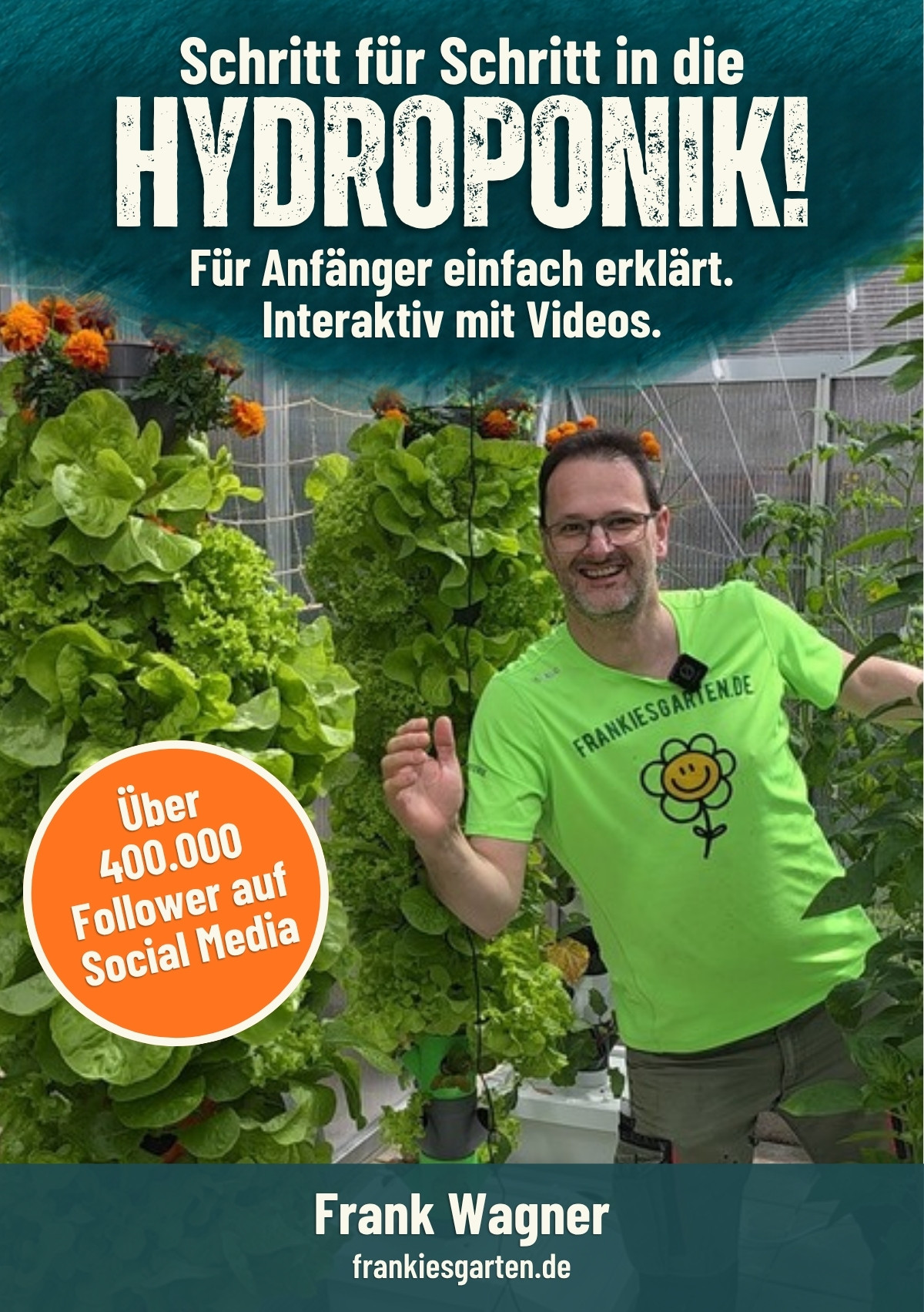
168 pages, simply explained for beginners and with videos on the topics (in German). Exactly how I grow myself: from sowing to harvest.
More about the book ›A few questions about space, location and what you want to harvest, and you get a recommendation.
To the tower advisor ›Questions about your setup? Message me on WhatsApp.
Tapping opens WhatsApp (provider: WhatsApp Ireland Ltd.). More in the privacy policy.