The future of hydroponics: what research and practice show today
Urban farming, less water, more yield in a small area, vegetables in space and sensors in your own tower. Here you can read what studies really prove, where the challenges lie and how I picture my own future with hydroponics.
The future of hydroponics: not a crystal ball, but facts
The future of hydroponics looks promising, and there are many ways this innovative growing method could revolutionise how we grow food. Here are some key aspects that highlight the potential of hydroponics for future agricultural practices:
A lot is promised about the future of hydroponics. Here I stick to what research and practice already show today. Where something is still an outlook, I say so. What you read here comes from university studies, from NASA, from the German Aerospace Center and from my own growing.
You can read where hydroponics comes from on my page about the history of hydroponics. This page is about where the journey is heading.
Urban farming and shorter supply chains
Hydroponics makes it possible to grow plants in urban environments, even inside buildings or on roofs. That shortens transport routes, and the vegetables reach consumers fresher. Whether less CO2 is produced overall depends mainly on the electricity for light and climate: transport usually accounts for only a small part of the emissions from food. Cities could grow part of their fresh vegetables themselves this way, especially lettuce, herbs and leafy greens. That makes supply less dependent on long supply chains.
What universities are researching
With hydroponics you can grow where there is no good soil: on roofs, in halls, on house walls or on the balcony. Universities are researching intensively how this can work on a large scale. At Cornell University in the USA, for example, a research group compares what leafy greens for New York and Chicago cost and consume: grown in the field in California and transported, in a greenhouse in the city, or in a hall with lamps on several levels.
A separate Cornell University programme is working on growing lettuce, tomatoes and strawberries in the greenhouse with less energy. The most important tools for this are smart control of the LED lighting and more CO2 in the air. This is exactly where the key to the future lies: using light so that every kilowatt hour brings as much harvest as possible.
Roofs and halls
Growing right where people live, without farmland.
Short distances
The vegetables arrive fresh instead of travelling for days.
Electricity decides
How much CO2 is produced depends mainly on the electricity for light and climate.
Greater efficiency and careful use of water and fertiliser
Hydroponic systems use water and nutrients more efficiently than traditional soil growing. Thanks to the closed loop, water is recycled, which greatly reduces consumption. At the same time, the precise control of nutrient supply allows fertiliser use to be reduced, and because the nutrient solution stays in the loop, hardly any fertiliser reaches the groundwater.
What a lettuce study shows
In 2015 researchers at Arizona State University calculated what lettuce in a hydroponic greenhouse needs compared with growing in the field. The basis was the location of Yuma in Arizona, an important lettuce-growing area in the USA. The result nicely shows both the strengths and the challenges of hydroponics.
| Per kilogram of lettuce and year | Hydroponics in the greenhouse | Growing in the field |
|---|---|---|
| Yield per square metre | about 41 kg | about 3.9 kg |
| Water | about 20 litres | about 250 litres |
| Energy | about 90,000 kJ | about 1,100 kJ |
Hydroponics brought about 11 times more yield on the same area and needed only a fraction of the water. The reason is the closed loop: the water runs past the roots again and again instead of seeping into the ground. In return the greenhouse needed about 82 times as much energy, mainly for light, heating and cooling.
Growing in hostile environments
Hydroponics can be used in areas where soil growing is not possible because of poor soil quality or extreme weather. This opens up new possibilities for growing food in desert regions, in polar areas or even in space, which could be particularly relevant for future Mars missions.
Fresh vegetables in space: NASA research
For a journey to Mars, which can take two to three years, packaged supplies alone are not really enough. Vitamins and quality decline over time. That is why NASA sees freshly grown vegetables as an important supplement. On the ISS space station, plants already grow without soil under LED light in the Veggie system. In August 2015 astronauts there ate home-grown lettuce for the first time.
Vegetables in Antarctica: the EDEN ISS project
In the EDEN ISS project, the German Aerospace Center operated a greenhouse in Antarctica. Lettuce, radishes, cucumbers, tomatoes, peppers and herbs grew there without soil, under artificial light and in a closed water loop. The project was meant to show how astronauts on the Moon and Mars can be supplied with fresh vegetables, and how vegetables can grow even in very harsh climates on Earth.
Desert
Hardly any rain, poor soil: the loop saves the scarce water.
Polar regions
EDEN ISS in Antarctica: vegetables under lamps in an icy climate.
Moon and Mars
Fresh vegetables are meant to supplement supplies on long journeys.
HydroFlex Tower for indoors and outdoors, seedling box, seedling station, support rings and my own nutrient. After you buy, I’ll help you on WhatsApp.
To the shop ›Year-round production
Because hydroponic systems are operated in controlled environments, growing is possible independently of the season. That allows fresh vegetables and fruit such as strawberries all year round, which can reduce dependence on seasonal growing cycles and the associated price fluctuations. In winter this needs light and warmth, in other words energy.
Harvest whenever you like
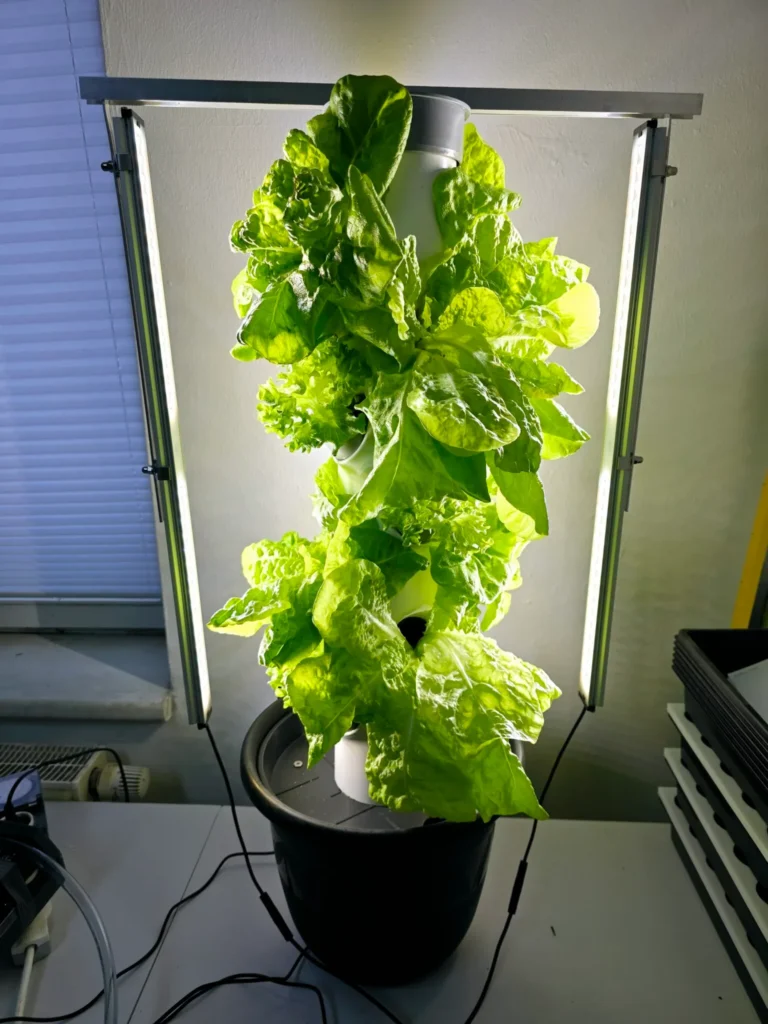
Indoors you can grow all year round. In winter, however, daylight at the window is often not enough. Then a grow light helps, which you hang at the side of the tower, 20 to 30 cm from the plants and for at most 16 hours a day. More on this on my page about lighting.
📖How to harvest all year round is in my book in the chapter “365 Tage ernten” (Harvesting 365 days). Just check the table of contents.›Reduced pesticide use
In hydroponic systems the plants come into less contact with pests and pathogens present in the soil. That can significantly reduce the need for plant protection products, and fewer residues end up on the vegetables. But hydroponics is not completely free of pests either: aphids, thrips and spider mites come through the air, and root diseases such as Pythium can even spread quickly in the loop.
Less trouble with soil pests
Without soil, pests and diseases that live in the soil have a harder time. But you are not completely free of them: aphids, thrips or spider mites can also appear on plants in the tower. How to recognise them and what to do is explained under pests and diseases.
Gone
- ✔Pests from the soil
- ✔Weeds
- ✔Soil fungi on the roots
Still an issue
- ✔Aphids, thrips, spider mites
- ✔Powdery mildew in humid air
- ✔Root rot in warm water
A few questions about space, location and what you want to harvest, and you get a recommendation.
To the tower advisor ›Integrating technology and data analysis
The future of hydroponics could be shaped by the increased use of IoT (Internet of Things) devices, sensors and artificial intelligence. These technologies can be used to monitor and optimise growing conditions, which can further increase efficiency and productivity.
Sensors and automation in your own tower
What runs in research greenhouses is coming to your home bit by bit. There are already meters that permanently measure and display the EC, pH and temperature of the nutrient solution in the tank. A digital timer with a cycle function controls the pump, and LED lamps bring the light exactly where it is needed.
With a smart home, lamps, fans and heating can even be switched based on sensors, for example a fan that starts by itself when humidity is high. What remains important: the technology takes work off your hands, but it does not replace understanding your plants. Always EC first, then pH, and my pH target is 5.8. More on this on the EC value and the pH value.
 UIUZMAR pH EC TDS Messgerät 7 in 1 pH WertsContinuous monitor for the tank: shows pH, EC and temperature of the nutrient solution around the clock.52,34 EURView on Amazon*To Amazon*
 Intervalltimer(1s-999h) Zeitrelais-SteckdoseDigital timer with cycle function. Indoors I set 5 minutes on and 30 minutes off.14,99 EURView on Amazon*To Amazon*
 MARS HYDRO VG40 LED Pflanzenlampe 60cm IP65LED grow light for indoors. I hang it at the side of the tower, 20 to 30 cm from the plants.59,99 EURView on Amazon*To Amazon*
* Affiliate link: if you buy through it, I earn a small commission. Your price stays the same. Prices incl. VAT, as of 8.11.2026.
* Affiliate links: I earn a commission if you buy, your price stays the same.
📖How to measure and adjust EC and pH, step by step, is in my book in the chapter “EC und pH” (EC and pH). Just check the table of contents.›Education and community gardens
Hydroponics also offers great educational opportunities. Schools and community centres could use hydroponics to teach important knowledge about growing methods that need little water and to run community gardens.
A tower in the classroom shows very clearly how plants grow and what they need. The roots are visible, pH and EC can be measured, and after a few weeks there is the first lettuce. That turns biology and chemistry lessons into something hands-on.
Measure and understand
pH, EC and water temperature: hands-on science.
Harvest together
A tower in a community garden brings a lot of harvest on little space.
From seed to harvest
Children experience the whole journey, from cube to plate.
Hydroponics at home
The future of hydroponics does not only happen in research halls but also on your windowsill. You do not need a garden; you need enough light, suitable temperatures and a good location. A hydro tower uses height and saves floor space, which is why it fits on a small balcony or in a corner of the living room.
A closed loop
In the tower the pump carries the nutrient solution up, it runs past the roots and back into the container. The water is used again and again. You can simply top up with ready-mixed nutrient solution instead of changing all the water. So you save water, fertiliser and time.

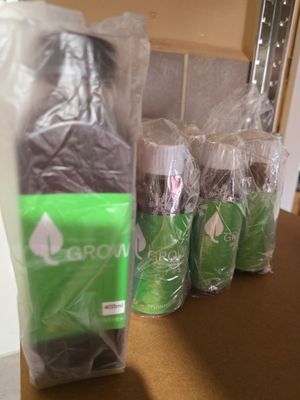
Seedling and leaf nutrient from one bottle, with calcium and magnesium, made for soft water. For all plants from sowing to the growth phase, leafy plants until harvest.
View in the shop ›My own future with hydroponics
The future will not get cheaper. That is why my goal is to be as independent as possible. The foundation for this is that I taught myself hydroponics. Then there is electricity: for pumps and lamps, power from your own solar system is ideal.
My big goal is a growing room under the roof where I can grow all year round, with air conditioning, heating, humidity control and ventilation, all controlled via my smart home. Sensors there regulate humidity by themselves, for example. I will pass on everything I learn along the way to you.
Final thoughts
Hydroponics will not replace agriculture, but it can noticeably change it and complement it sensibly, especially for lettuce, herbs and fruiting vegetables close to cities. With its ability to offer efficient and space-saving growing methods, it has the potential to become an important pillar of food production in cities.
For you at home this means: you can already grow lettuce, herbs and vegetables without soil today, on the windowsill, on the balcony or in the greenhouse.
Related:Myths and facts: what is really true about hydroponics›


Frequently asked questions about the future of hydroponics
What does urban farming mean?
Do vegetables from the city automatically save CO2?
How much water does hydroponics save with lettuce?
How much more yield does hydroponics bring on the same area?
What is the biggest challenge of hydroponics?
Where was the well-known lettuce study calculated?
Why does hydroponics need less water?
Does fertiliser reach the groundwater with hydroponics?
Where can hydroponics be used where soil growing does not work?
What is Cornell University researching?
Why is NASA interested in hydroponics?
How long can a journey to Mars take?
When was home-grown lettuce first eaten on the ISS?
What was grown at EDEN ISS in Antarctica?
What was the EDEN ISS greenhouse intended for?
Can I harvest all year round with hydroponics?
Are there no pests in hydroponics?
Does hydroponics need fewer plant protection products?
Which technology can I already use in my own tower today?
What role does artificial intelligence play in hydroponics?
Do sensors replace your own measuring?
How long does the pump run in the tower?
Is hydroponics suitable for schools and community gardens?
How does Frank save electricity for his growing?
What is Frank’s dream for his growing?
Do I have to change all the water when topping up?
Do I need a garden for hydroponics?
Does hydroponics replace agriculture?
You will find more basics on my page Hydroponics for beginners, on advantages and on myths and facts.
Continue with your own growing
168 pages, simply explained for beginners and with videos on the topics (in German). Exactly how I grow myself: from sowing to harvest.
More about the book ›A few questions about space, location and what you want to harvest, and you get a recommendation.
To the tower advisor ›Questions about your setup? Message me on WhatsApp.
Tapping opens WhatsApp (provider: WhatsApp Ireland Ltd.). More in the privacy policy.