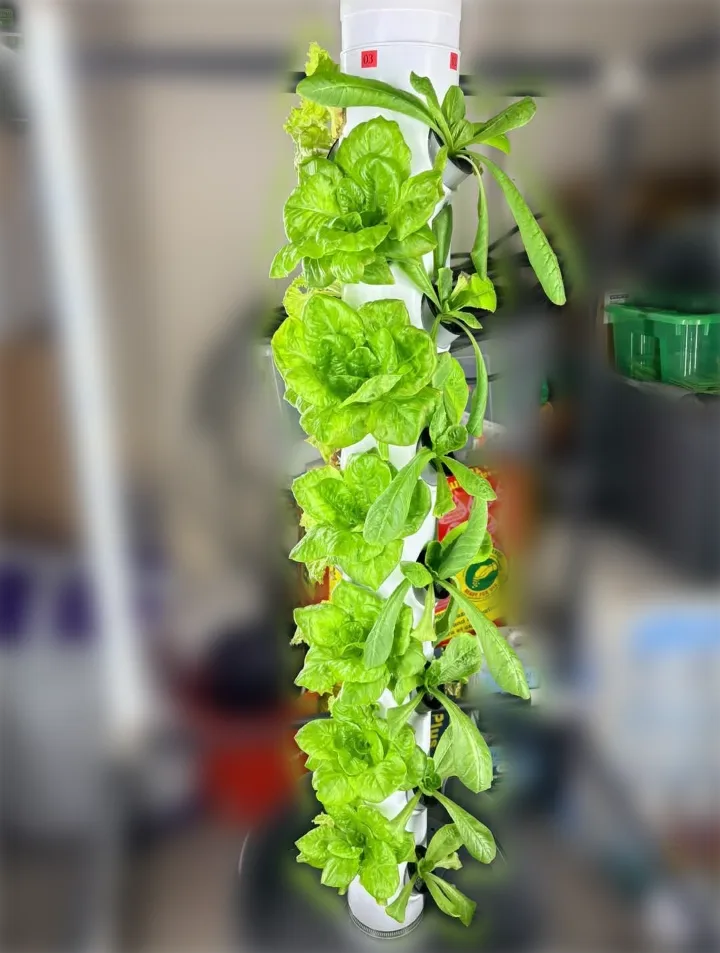
Lettuce leaves turning brown at the edges: causes and solutions
Brown, dry edges on young lettuce leaves? Most of the time it is tipburn. Here you will learn what causes it and how your lettuce grows cleanly again.
Brown leaf edges on lettuce: the causes at a glance
Brown, dry edges on young lettuce leaves look bad at first, but they are easy to get under control. Almost always the cause is tipburn. The lettuce grows so fast that calcium does not reach the edges of the young leaves. With a few simple changes it grows cleanly again.
Yellow instead of brown leaves? Then read my article Plant turning yellow: causes and solutions.
What is tipburn in lettuce?
Calcium only travels up through the plant with the water flow from the roots. This flow exists because the leaves evaporate water. Large outer leaves evaporate a lot and get enough calcium. The young leaves in the heart of the lettuce hardly evaporate, because they sit close together and get little air. If the lettuce then grows fast, there is not enough calcium at the leaf edges. The cells there die, the edge turns brown and dry.
The good news: it is not a disease and it does not spread. It is a growth disorder that you control with air, light and the nutrient solution. Experts agree that air movement into the heart of the lettuce reliably prevents tipburn.
How to recognise tipburn
- The edges of the young, inner leaves turn brown, dry or almost black.
- The outer, older leaves look healthy.
- Often only one variety is affected while the others next to it stay perfect.
- Brown edges on the old, outer leaves are more likely caused by too much nutrient (salt). Then a lower EC helps most.
Cause 1: Too little air movement
This is the most important point, especially indoors. When the air stands still, a humid layer sits around every leaf. The leaves hardly evaporate, and without evaporation no calcium reaches the young edges. A gentle breeze solves exactly that.
How to fix it
The right amount matters: the leaves should only move slightly, like in a gentle breeze. A storm blowing straight at the lettuce dries the leaves out, and then the edges turn brown all the more.
- Set the fan gently: the leaves sway slightly, they do not flap.
- If the airflow is stronger, place the fan further away. Even better is a model you can turn down smoothly to a very gentle setting.
- Do not point it directly at a single plant all the time, let it swing back and forth instead.
- The easiest way: switch it on together with the lamp.

* Affiliate link: if you buy, I earn a small commission, your price stays the same.
How it was for me
I have had brown edges on my lettuce too. In the end, it was not calcium deficiency at all: the leaves simply dried out at the edges. The air hardly moved, and the lamp hung close and ran for a long time. So I added more air movement, shortened the lamp time and hung the lamp higher. After that, the new leaves came through nice and clean again.
More on this: Humidity and air circulation
My book “Schritt für Schritt in die Hydroponik!” (in German) has its own chapter “Braune Blattränder” (brown leaf edges): what caused it for me, what I changed and how calcium gets all the way into the leaves. Plus tables for many plants and everything explained step by step.
View the book on Amazon*Cause 2: The EC is slightly too high
More nutrient does not mean more growth. If the solution is very strong, it is harder for the roots to take up water, and less calcium reaches the leaves. Trials show: the higher the EC for lettuce, the more often tipburn appears.
I grow my lettuce with soft water at EC 1.1 to 1.2. Fully grown plants get 1.6 at most. If you are already at the upper end and one variety gets brown edges, lower the EC a little.
How to fix it
- Check EC and pH with a meter*.
- With brown edges, lower the EC to about 1.1 to 1.2: simply dilute with fresh water.
- Keep the pH at 5.8 to 6.0, then the lettuce can take up calcium well.
- Everything about the values is on my pages EC value and pH value.
 BeginnerPious 5-in-1 meterShows you in a minute whether your EC is too high for lettuce.39,99 EURView on Amazon*To Amazon*
 ProBluelab OnePenMeasures very precisely and saves the values in the app, so you can see when the EC rises.203,15 EURView on Amazon*To Amazon*
 Lower pHPhosphoric acid (pH down)A few drops bring the pH to 5.8, so the lettuce can take up calcium and all other nutrients well.18,90 EURView on Amazon*To Amazon*
* Affiliate link: if you buy, I earn a commission, your price stays the same.
Values for lettuce and other leafy plants
You can grow lettuce, herbs and leafy greens together in one tower. Here you can see the range each plant likes and the single value I run them all on.
| Plant | pH | EC | My value in the tower |
|---|---|---|---|
| Lettuce | 5.5 to 6.5 | 1.2 to 1.6 | 1.2 |
| Basil | 5.5 to 6.5 | 1.0 to 1.8 | 1.2 |
| Parsley | 5.5 to 6.0 | 0.8 to 1.2 | 1.2 |
| Rocket | 6.0 to 6.5 | 0.8 to 1.2 | 1.2 |
| Mint | 5.5 to 6.5 | 1.0 to 1.6 | 1.2 |
| Chives | 6.0 to 6.5 | 1.0 to 1.8 | 1.2 |
Why all leafy plants get along with one value: Do different vegetables need different values?
Cause 3: Lots of light and heat, the lettuce grows too fast
This is the interesting part: it is often healthy, fast-growing lettuce that gets tipburn. Lots of light and warmth push growth, and the young leaves grow faster than calcium can follow. Studies show the risk rises clearly when the daily amount of light is very high.
With about 200 PPFD for 14 hours you are on the safe side. That is a daily light integral of around 10 mol per square metre. It only becomes critical from about 17 mol, so with much more light or longer lighting.
How to fix it
- Do not light for more than 16 hours.
- If the room gets warmer than 25 °C, hang the lamp a little higher or move the light period into cooler hours.
- Check the amount of light with a PAR meter* instead of guessing. More on my page lighting.
 Measure lightPAR meterShows you the real amount of light at the lettuce, so you know whether it gets too much light and grows too fast.94,99 EURView on Amazon*To Amazon*
 Grow lightMars Hydro VG40Even plant light for herbs on the tower. Hung to the side with some distance, nothing bleaches.59,99 EURView on Amazon*To Amazon*
* Affiliate link: if you buy, I earn a commission, your price stays the same.
Where to find the light values of your lamp
PPFD tells you how much usable light reaches one square metre of leaf area every second. The higher the number, the brighter.
Good manufacturers show this in a light map, often called a PPFD or PAR map. You will find it in the product pictures or the description of the lamp. It lists a value for many points under the lamp, usually for a set distance such as 30 or 45 cm. The centre is brightest, the edges get less. Hang the lamp higher and the value drops.
For lettuce, 150 to 250 PPFD is plenty. Add the hours and you get the daily light amount, the DLI: PPFD times hours times 0.0036. At 200 PPFD for 14 hours that is 200 times 14 times 0.0036, about 10. Lettuce grows best at 12 to 17. That is rather gentle and perfectly fine for lettuce. If the lamp hangs very close or runs very long, however, the edges dry out more easily. Then more distance and a few hours less help.
No light map at hand? A PAR meter shows you the real value right at the leaf.
My lamps and my grow shelf
I start my lettuce and herbs on a grow shelf with four levels. Each level has its own LED bar, so the young plants grow strong and compact before they move into the tower. It is the easiest way to harvest indoors all year round.

* Affiliate link: if you buy, I earn a small commission, your price stays the same.
Cause 4: Some lettuce varieties are more sensitive
If only one of three varieties gets brown edges, that is a very typical picture. Lettuce varieties differ a lot in how prone they are to tipburn. Head and butterhead lettuce with a tightly closed heart are affected more often because little air gets inside. Loose-leaf lettuces with open leaves usually stay clean.
How to fix it
- Harvest the sensitive variety a little earlier, before the heart closes completely.
- Put this variety in the airiest spot of the tower, where the fan reaches it well.
- Next time combine it with open loose-leaf lettuces like Lollo or oak leaf. My varieties and values are in lettuce without soil.
When the lowest leaves at the pot die off
Sometimes it is not the young leaves in the heart that are brown, but the oldest, lowest leaves right at the net pot. They hang over the rim, turn brown and papery and collapse, while everything on top keeps growing green. That is exactly how it was for Wilhelm from our community, you will find his question with all values here: Lettuce in the tower: the lower leaves are rotting. It is a different picture from tipburn and usually has quite different causes.
1. The variety does not suit a vertical tower
Not every lettuce is suitable for hydroponics, even if it is sold for it. Indoors under a lamp, lettuce grows differently than outdoors in a bed. Loose-leaf lettuces with flat, frilly leaves spread their lower leaves wide. In a tower, these leaves then hang down over the rim of the pot, kink and lie against the wet pot. That is exactly where they die first. Upright varieties such as romaine or butterhead hardly have this problem. You can see it with Wilhelm too: his two other varieties stand right next to it in perfect health.
2. Leaves that are always wet at the pot
The lowest leaves lie directly on the wet, algae-covered cube and against the pot. Anything that stays wet and gets little light starts to rot. Grey mould and other fungi start exactly there: on old leaves lying on a wet surface.
3. A look at the roots
“It looks as if it is too dry, but it isn’t”: this sentence from Wilhelm is an important clue. If a plant droops even though there is enough water, it is worth checking the roots. Healthy roots are white to cream. If they are brown and slimy, water no longer reaches the leaves properly, and the outer leaves turn yellow and wilt first. This happens mainly when the water gets warm and has little oxygen.
How to fix it
- Pick off brown, dead leaves right away so the rest stays healthy.
- Cover cube and pot with support rings: no light, no algae, and the leaves no longer lie directly on the wet cube.
- Check the roots: white is good, brown and slimy is not.
- Keep the water temperature below 22 °C.
- Next time choose an upright variety, for example romaine or butterhead.
My tip: always harvest loose-leaf lettuce in the tower from the outside. That way the outer leaves end up on your plate before they get old and hang on the pot. And the lettuce keeps growing from the inside.
Cause 5: The roots are stressed
Calcium comes in through the roots. If they are not doing well, the edges of the young leaves suffer first. I often see two things here.
Algae on the cubes
Green cubes show that light hits the wet surface. The algae themselves hardly harm the lettuce, but they compete for oxygen and nutrients. Cover the planting holes and the problem is gone. My support rings from the shop cover the pot against light and give the lettuce support at the same time. More on my page algae.
Pump times
Indoors my pump runs 5 minutes on and 30 minutes off. That works for lettuce. If it gets very warm or the air is dry, shorten the break to 15 to 20 minutes so the roots never dry out.
Cause 6: Too little calcium in the nutrient
This is rather rare, but it happens when a nutrient without calcium or very soft water without compensation is used. A good hydroponic nutrient for leafy plants already contains calcium and magnesium.
My liquid nutrient for leafy plants contains calcium and magnesium and is made for soft water. You find it in my shop.
By the way, calcium as a leaf spray only helps briefly and makes the leaves wet. Air movement and the right EC work much better.
Brown leaf edges on lettuce: step by step
Always change only one thing at a time and then watch the new leaves for three to four days. The old brown edges stay, what matters is that the new leaves grow back clean.
- Air: set up a fan, the leaves should move gently, also at night.
- Measure EC: if it is above 1.3, dilute with fresh water to 1.1 to 1.2.
- Check pH: set it to 5.8 to 6.0.
- Light and heat: no more than 16 hours of light, room below 25 °C if possible.
- Cover the cubes: protect planting holes from light, then the algae disappear.
- Sensitive variety: harvest a little earlier or move it to the airiest spot.
Write it as a comment under my latest video on YouTube, TikTok or Instagram. I answer the most exciting questions here in the blog and in my videos.
No tower of your own yet? The tower advisor finds the right one for your windowsill, balcony or garden in a minute. And on my recommendations page you can see everything else I use.
Did you enjoy this topic? Is anything missing, or do you see something differently? I keep learning all the time and I would love to hear your question and your experience. Just write it in the comments below, no sign-up needed.
Write your question or experienceFAQ: brown leaf edges on lettuce
Why does my lettuce get brown leaf edges?
Usually it is tipburn: with fast growth, calcium does not reach the edges of the young leaves. The most common triggers are still air, an EC that is too high and lots of light and heat.
Is tipburn a disease?
No. It is a growth disorder, nothing contagious. The lettuce is still edible, simply cut off the brown edges.
Why is only one lettuce variety affected?
Varieties differ in sensitivity. Lettuces with a tightly closed heart such as head lettuce and butterhead get tipburn more easily than open loose-leaf lettuces.
Does a fan help against tipburn?
Yes, it is the most effective measure. A gentle breeze lets the young leaves evaporate water too, so calcium reaches the edges.
Which EC is right for lettuce?
I grow lettuce with soft water at EC 1.1 to 1.2, fully grown 1.6 at most. With brown edges, rather lower the EC a little.
Which pH is right for lettuce?
pH 5.8 to 6.0. I set it to 5.8.
Can too much light cause brown edges?
Indirectly, yes. Lots of light makes lettuce grow very fast, and then calcium cannot keep up. 200 PPFD for 14 hours is good for lettuce.
Do I need to add extra calcium?
Usually not. A good nutrient for leafy plants already contains calcium and magnesium. It is more important that air movement brings the calcium into the leaves.
Does a calcium leaf spray help?
Only briefly. It makes the leaves wet, which can encourage fungi. Air movement and the right EC work better.
Do the brown leaves turn green again?
No, the brown edges stay. What matters is that the new leaves grow back clean. You will see that after three to four days.
Why are my rockwool cubes green?
Light falls on the wet surface and algae grow. Cover the planting holes, for example with my support rings, and the problem is gone.
How often should the pump run for lettuce?
Indoors I run it 5 minutes on and 30 minutes off. In heat or dry air, shorten the break to 15 to 20 minutes.
Why are the lowest lettuce leaves in my tower dying?
Usually the oldest leaves hang over the rim of the pot, kink and lie against the wet pot. That is where they wilt and rot first. Loose-leaf lettuces are affected more often than upright varieties. Also check the roots: if they are brown and slimy, too little water reaches the leaves.
Which lettuce varieties suit a hydroponic tower?
Upright varieties such as romaine and butterhead are best. Loose-leaf lettuce works too, but then harvest regularly from the outside so the old leaves do not hang on the pot.
What do healthy roots look like?
White to cream and firm. Brown, slimy roots show that something is wrong, often the water is too warm or has too little oxygen.