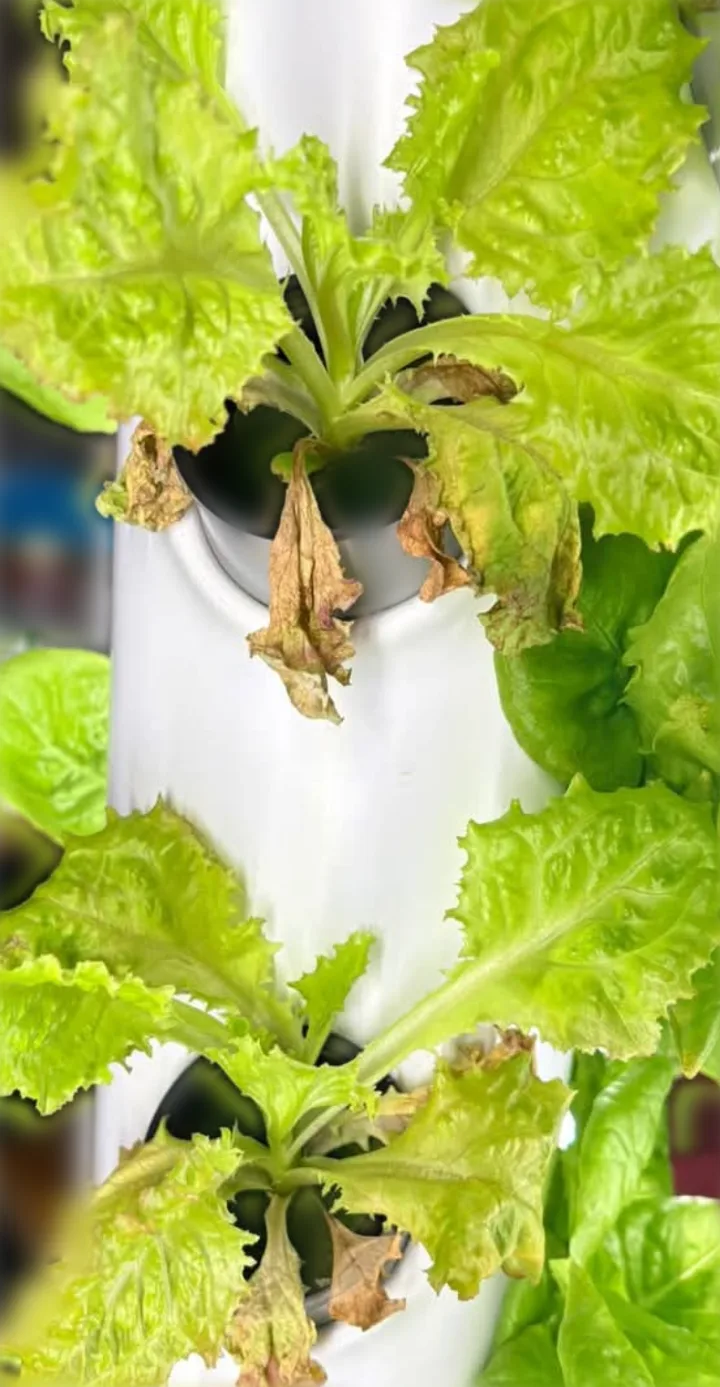
Lettuce in the tower: the lower leaves are rotting
Wilhelm grows three lettuce varieties in his tower. On one of them, the lowest leaves turn brown and rot away, while the others are thriving. Here you will find out why and how to fix it easily.
In short: the oldest leaves at the pot are dying, and that is easy to change
With Wilhelm it is mainly the lowest, oldest leaves right at the pot that are dying. That is usually down to the variety and how the leaves hang in the tower. A bit of dryness at the edges comes on top. With the right variety, harvesting from the outside and some air movement, it is quickly under control.
Wilhelm’s question
Wilhelm asked his question in a hydroponics group on Facebook and kindly allowed me to show his photos and his question here. Thank you, Wilhelm! Here is his full question:
Wilhelm’s question from a hydroponics group on Facebook, as he wrote it (translated):
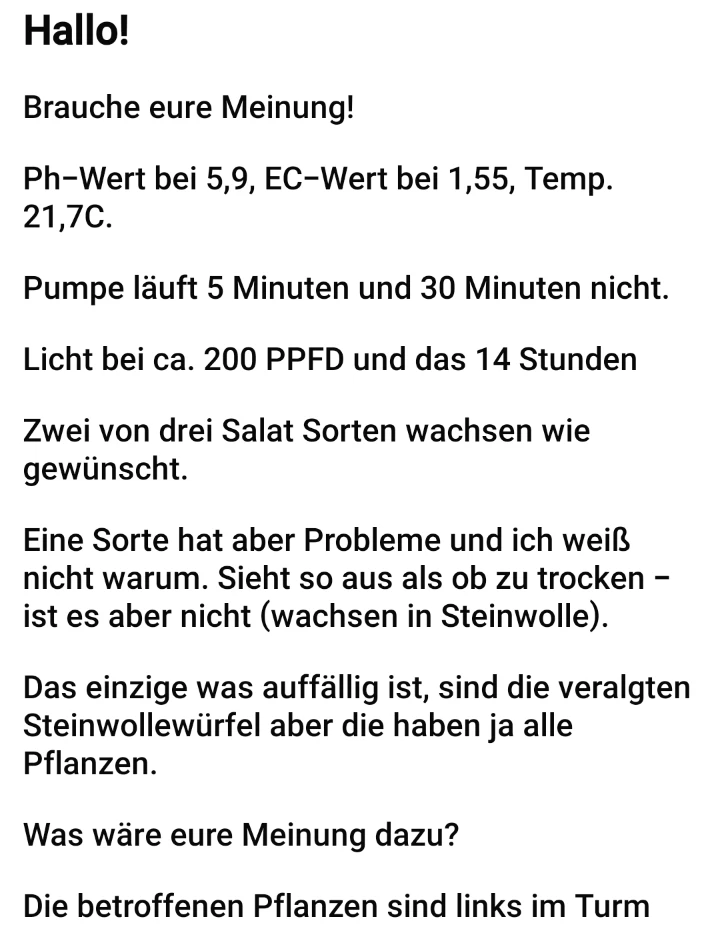
“Hello! I need your opinion! pH at 5.9, EC at 1.55, temperature 21.7 °C. The pump runs for 5 minutes and is off for 30 minutes. Light at about 200 PPFD for 14 hours. Two of three lettuce varieties grow as they should. But one variety has problems and I don’t know why. It looks as if it is too dry, but it isn’t (they grow in rockwool). The only thing that stands out are the algae-covered rockwool cubes, but all plants have those. What do you think? The affected plants are on the left of the tower in the first photo.”
Value check: what is fine for Wilhelm and what I would change
| Value | Wilhelm | My tip |
|---|---|---|
| pH | 5.9 | Spot on, 5.8 to 6.0 |
| EC | 1.55 | A bit high, 1.1 to 1.2 for lettuce |
| Water temperature | 21.7 °C | Good, 18 to 22 °C is ideal |
| Pump | 5 min on, 30 min off | Fine for indoors |
| Light | approx. 200 PPFD, 14 h | Fine, up to 16 hours is welcome |
| Rockwool | algae on the cubes | Cover so no light hits it |
What is happening with Wilhelm: the lower leaves are rotting
Looking closely at Wilhelm’s photos, you can see it: the young leaves on top are not the problem, but the oldest, lowest leaves right at the net pot. They hang over the rim of the pot, turn brown, mushy or papery and collapse. The new leaves on top, however, keep growing nice and green. There are three typical reasons for this, and all of them are easy to change.
Cause 1: the variety does not suit a vertical tower
Not every lettuce is suitable for hydroponics, even if it is sold for it. Indoors under a lamp, lettuce grows differently than outdoors in a bed. Loose-leaf lettuces with flat, frilly leaves spread their lower leaves wide. In a tower, these leaves then hang down over the rim of the pot, kink and lie against the wet pot. That is exactly where they die first. Upright varieties such as romaine or butterhead hardly have this problem. You can see it with Wilhelm too: his two other varieties stand right next to it in perfect health.
My tip: always harvest loose-leaf lettuce in the tower from the outside. That way the outer leaves end up on your plate before they get old and hang on the pot. And the lettuce keeps growing from the inside.
Cause 2: the lower leaves are constantly wet
The lowest leaves lie directly on the wet, algae-covered cube and against the pot. Anything that stays wet and gets little light starts to rot. Grey mould and other fungi start exactly there: on old leaves lying on a wet surface.
My own support rings help against algae on the cubes: they cover the net pot, so no light falls on the wet rockwool, and they also hold heavy plants in place. You will find them in my shop.
Cause 3: stress at the roots
“It looks as if it is too dry, but it isn’t”: this sentence from Wilhelm is an important clue. If a plant droops even though there is enough water, it is worth checking the roots. Healthy roots are white to cream. If they are brown and slimy, water no longer reaches the leaves properly, and the outer leaves turn yellow and wilt first. This happens mainly when the water gets warm and has little oxygen.
And the brown edges on some leaves?
On some leaves, the edges are also dry and brown. That is only a side issue: usually a little too little air movement and a slightly high EC. You will find everything about it on my page Lettuce leaves turning brown at the edges.
How to get it under control
- Pick off dead leaves: remove brown and mushy leaves right away so the rest stays healthy.
- Cover the pot: put on support rings so no light hits the cube and the leaves no longer lie in the wet.
- Check the roots: white is good, brown and slimy is not.
- Keep the water cool: below 22 °C.
- Lower the EC: 1.1 to 1.2 for lettuce.
- Move the air: a small fan dries the lower leaves.
- Harvest from the outside: the old leaves end up on your plate before they rot.
- Next time: choose an upright variety such as romaine or butterhead.
EC and pH values for lettuce and other leafy plants
You can grow lettuce, herbs and leafy greens together in one tower. Here you can see the range each plant likes and the single value I run them all on.
| Plant | pH | EC | My value in the tower |
|---|---|---|---|
| Lettuce | 5.5 to 6.5 | 1.2 to 1.6 | 1.2 |
| Basil | 5.5 to 6.5 | 1.0 to 1.8 | 1.2 |
| Parsley | 5.5 to 6.0 | 0.8 to 1.2 | 1.2 |
| Rocket | 6.0 to 6.5 | 0.8 to 1.2 | 1.2 |
| Mint | 5.5 to 6.5 | 1.0 to 1.6 | 1.2 |
| Chives | 6.0 to 6.5 | 1.0 to 1.8 | 1.2 |
At EC 1.55 Wilhelm is at the upper end. For lettuce, 1.1 to 1.2 is enough. A little less nutrient relieves the roots and lets the leaves grow more calmly and strongly.
Why all leafy plants get along with one value: Do different vegetables need different values?
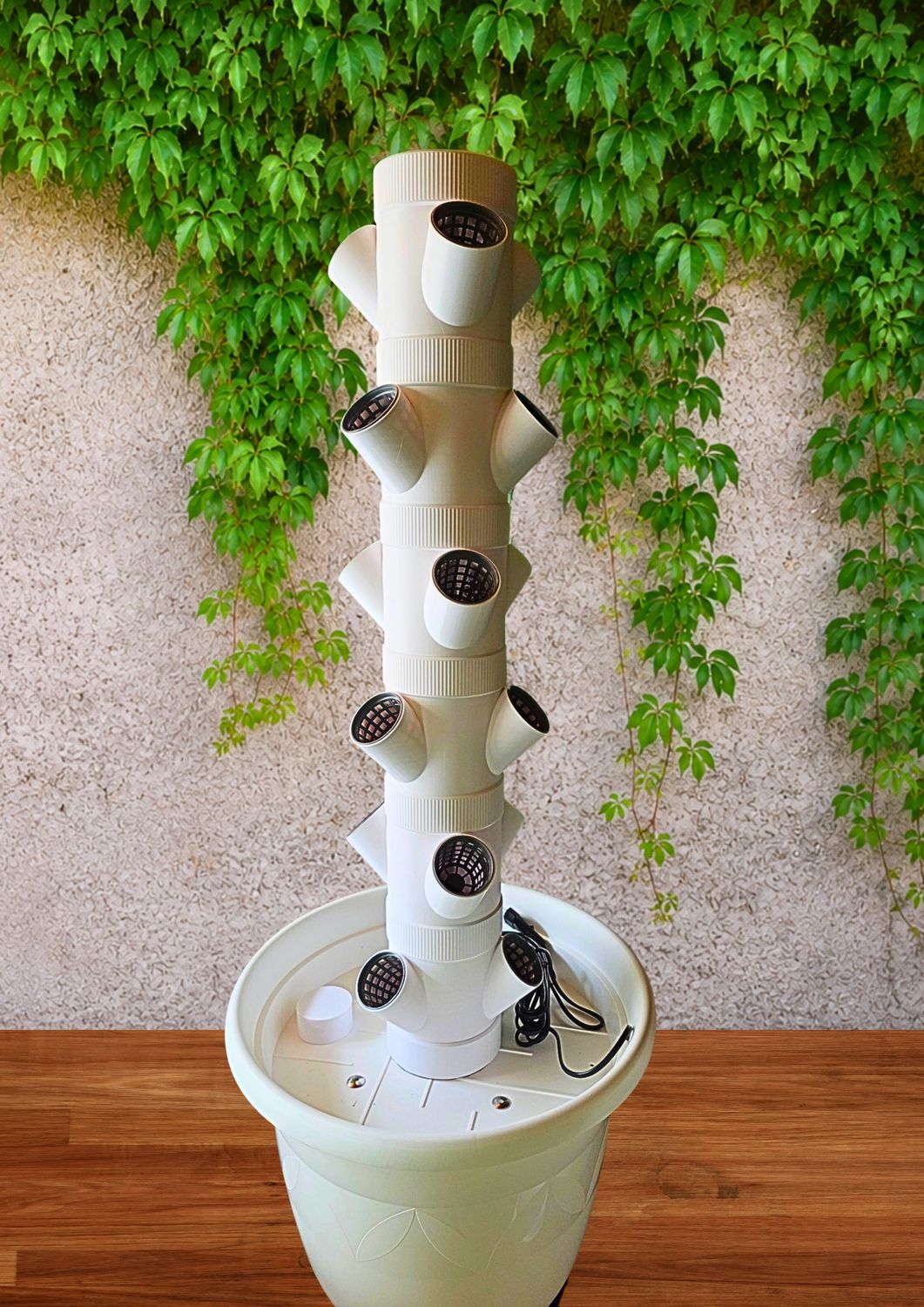
My tower for leafy plants
Harvest lettuce and herbs together: the HydroFlex Tower Classic 6+
17-litre tank and room for 18 plants or more. Just right if you want to grow lettuce, basil and parsley together.
Water values: what kind of water do you have?
Wilhelm gave us his pH, EC and temperature. But one more thing matters: how hard is his tap water? That decides which nutrient suits best.
The quickest way to find out is to ask your local water supplier, or measure it yourself: dip your EC meter into plain tap water, before adding any nutrient. If it shows less than about 0.3, your water is soft. If the value is clearly higher, it is rather hard. More on this on my page water quality.
For Wilhelm this check is especially worth it: if his water is hard, part of his 1.55 is already in the tap water itself and not in the nutrient at all.
Soft water: then my liquid nutrient is a perfect fit, it is made exactly for that. Calcium and magnesium are already included, you do not need anything extra.
Hard water: it already contains a lot of lime, the EC starts higher and the pH rises faster. The easiest way is to soften it with a reverse osmosis unit. Then my nutrient suits you too, and your values stay nice and stable.

* Affiliate link: if you buy, I receive a commission, your price stays the same.
Light: what PPFD means and how much lettuce needs
Wilhelm gave his light level in PPFD. PPFD tells you how much usable light reaches one square metre of leaf area every second. The higher the number, the brighter.
Good manufacturers show this in a light map, often called a PPFD or PAR map. You will find it in the product pictures or the description of the lamp. It lists a value for many points under the lamp, usually for a set distance such as 30 or 45 cm. The centre is brightest, the edges get less. Hang the lamp higher and the value drops.
For lettuce, 150 to 250 PPFD is plenty. Add the hours and you get the daily light amount, the DLI: PPFD times hours times 0.0036. For Wilhelm that is 200 times 14 times 0.0036, about 10. Lettuce grows best at 12 to 17. So Wilhelm’s light is rather gentle and not the reason for the brown edges. If the lamp hangs very close or runs very long, however, the edges dry out more easily. Then more distance and a few hours less help.
No light map at hand? A PAR meter shows you the real value right at the leaf.
 Measure lightPAR meterShows you the real amount of light at the lettuce, so you know whether it gets too much light and grows too fast.94,99 EURView on Amazon*To Amazon*
 Grow lightMars Hydro VG40Even plant light for herbs on the tower. Hung to the side with some distance, nothing bleaches.59,99 EURView on Amazon*To Amazon*
* Affiliate link: if you buy, I earn a commission, your price stays the same.
My lamps and my grow shelf
I start my lettuce and herbs on a grow shelf with four levels. Each level has its own LED bar, so the young plants grow strong and compact before they move into the tower. It is the easiest way to harvest indoors all year round.

* Affiliate link: if you buy, I earn a small commission, your price stays the same.
Air movement: the most important lever
Still air keeps the lower leaves wet, and that is exactly where the rotting starts. A small fan that gently moves the plants dries the leaves and helps the whole lettuce.
The right amount matters: the leaves should only move slightly, like in a gentle breeze. A storm blowing straight at the lettuce dries the leaves out, and then the edges turn brown all the more.
- Set the fan gently: the leaves sway slightly, they do not flap.
- If the airflow is stronger, place the fan further away. Even better is a model you can turn down smoothly to a very gentle setting.
- Do not point it directly at a single plant all the time, let it swing back and forth instead.
- The easiest way: switch it on together with the lamp.
For Wilhelm, exactly this kind of gentle breeze is enough: the lower leaves dry off without the edges drying out.

* Affiliate link: if you buy, I earn a small commission, your price stays the same.
How it was for me
I have had brown edges on my lettuce too. In the end, it was not calcium deficiency at all: the leaves simply dried out at the edges. The air hardly moved, and the lamp hung close and ran for a long time. So I added more air movement, shortened the lamp time and hung the lamp higher. After that, the new leaves came through nice and clean again.
More on this: Humidity and air circulation
My book “Schritt für Schritt in die Hydroponik!” (in German) has its own chapter “Braune Blattränder” (brown leaf edges): what caused it for me, what I changed and how calcium gets all the way into the leaves. Plus tables for many plants and everything explained step by step.
View the book on Amazon*The right nutrient: calcium and magnesium included
To make sure there is enough calcium in the water, I use my own liquid nutrient for all leafy plants. It already contains calcium and magnesium, is made for soft water and covers everything from sowing to harvest. One bottle, done.
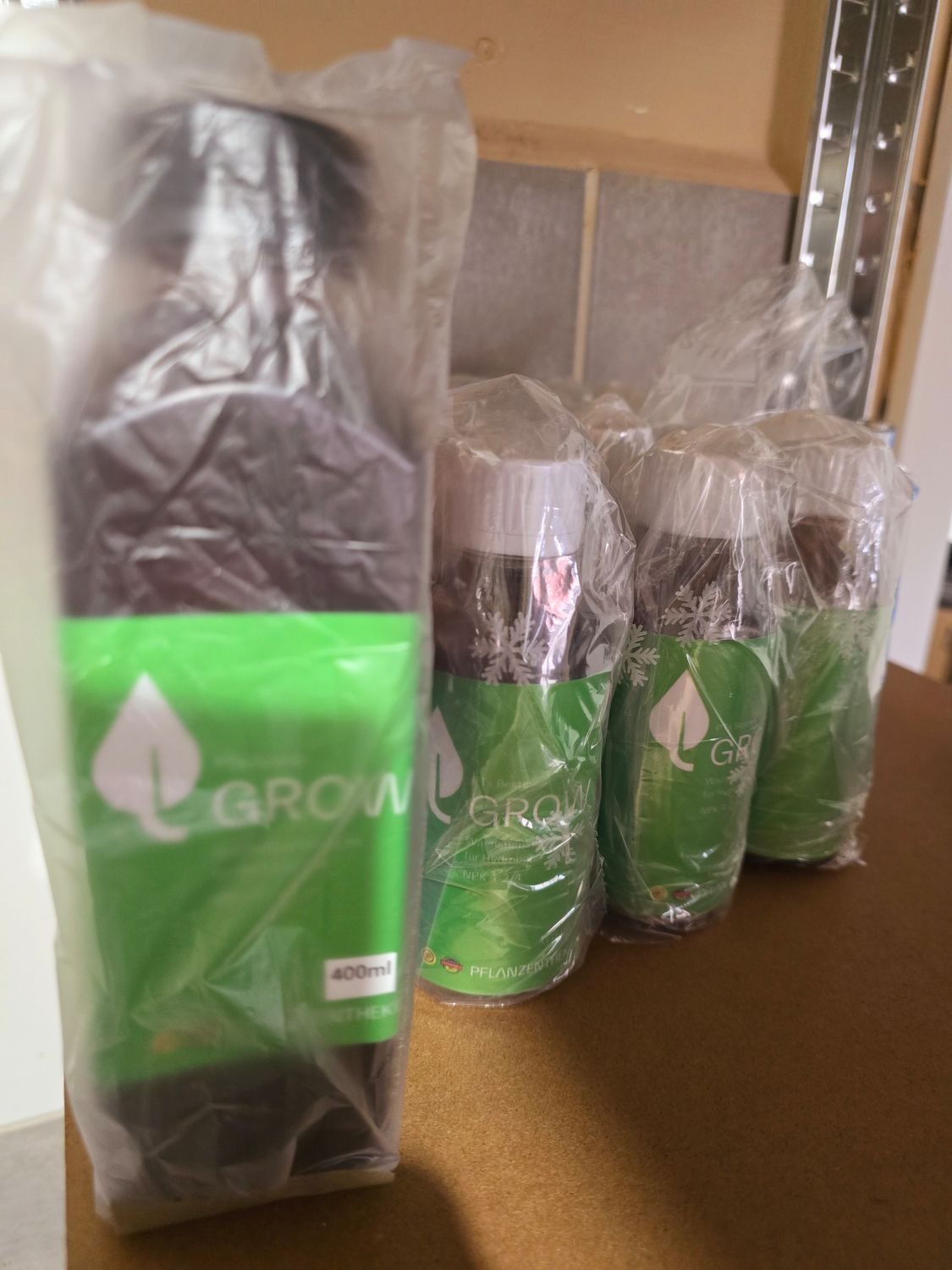
My nutrient
Frankie’s liquid nutrient for lettuce and herbs
With calcium, magnesium and chelated iron, made for soft water. One bottle from sowing to harvest.
How to mix and dose it: Liquid fertiliser guide
Measure correctly: so you know where you stand
Measure EC and pH twice a week. A good meter shows you both at a glance, so you notice right away when the value creeps up.
 BeginnerPious 5-in-1 meterTo get started: shows you in a minute whether your EC fits your plants.39,99 EURView on Amazon*To Amazon*
 ProBluelab OnePenMeasures very precisely and saves the values in the app, so you see how EC and pH change over the weeks.203,15 EURView on Amazon*To Amazon*
* Affiliate link: if you buy, I earn a commission, your price stays the same.
How to set EC and pH correctly is explained on my pages EC value and pH value.
Write it as a comment under my latest video on YouTube, TikTok or Instagram. I answer the most exciting questions here in the blog and in my videos.
No tower of your own yet? The tower advisor finds the right one for lettuce, herbs or tomatoes in a minute. And on my recommendations page you can see everything else I use.
* Affiliate link: if you buy, I earn a small commission, your price stays the same.
Did you enjoy this topic? Is anything missing, or do you see something differently? I keep learning all the time and I would love to hear your question and your experience. Just write it in the comments below, no sign-up needed.
Write your question or experienceFAQ: lettuce leaves rotting in the tower
Why are the lower lettuce leaves in my tower rotting?
Usually the oldest leaves hang over the rim of the pot, kink and lie against the wet pot or cube. That is where they wilt and rot first. Loose-leaf lettuces are affected more often than upright varieties. Also check the roots: if they are brown and slimy, too little water reaches the leaves.
Is this tipburn?
No. Tipburn shows on the young leaves in the heart. Here it is the oldest leaves right at the bottom of the pot, which has other causes.
Which lettuce varieties suit a hydroponic tower?
Upright varieties such as romaine and butterhead are best. Loose-leaf lettuce works too, but then harvest regularly from the outside so the old leaves do not hang on the pot.
Should I remove the dead leaves?
Yes, pick them off right away. That way nothing can spread and the plant puts its energy into new leaves.
Can I still eat the lettuce?
Yes. The healthy green leaves taste perfectly normal. Only the brown, mushy leaves go.
What do healthy roots look like?
White to cream and firm. Brown, slimy roots show that something is wrong, often the water is too warm or has too little oxygen.
What water temperature is right?
18 to 22 °C. Wilhelm’s 21.7 °C is still fine, it should not get warmer.
Are algae-covered rockwool cubes harmful?
The algae show that light reaches the wet surface, and the lower leaves then lie in the wet. Cover the cubes, for example with support rings.
What EC is right for lettuce?
With soft water, 1.1 to 1.2 is enough. Lettuce does not need more than 1.6.
What pH is right for lettuce?
5.8 to 6.0. That also suits herbs and other leafy greens in the same tower.
Does a fan help?
Yes. Gentle air movement dries the lower leaves, and that is usually where the rotting starts.
How often should I harvest loose-leaf lettuce?
Ideally a few outer leaves every few days. That keeps the lettuce young and fresh, and old leaves never get to hang on the pot.