Mit deinem HydroFlex Tower bekommst du nicht nur ein Paket, sondern eine Rundum-Begleitung. Ich lasse dich nicht allein, vom Samen bis zum Teller.
Schritt für Schritt mit Videos: Aufbau, Aussaat, Pumpenzeiten, Düngen, pH und EC
Persönliche Beratung per WhatsApp: 7 Tage die Woche, direkt von mir
Deine Fragen beantwortet: Kapitel für Kapitel, so wie im Buch
Anzuchtkarten und Werte: für deine Pflanzen zum Nachschlagen
Diese Fragen beantworte ich dir
Tippe auf ein Kapitel und schau, was dich erwartet:
1Kapitel 1Grundlagen
Was ist Hydroponik eigentlich?
Wo kann ich Hydroponik machen, drinnen oder draußen?
Was kann ich alles anbauen?
2Kapitel 2Anzucht
Worin säe ich meine Samen aus?
Wie viele Samen kommen in einen Würfel?
Brauche ich eine Anzuchtbox oder -station?
3Kapitel 3Keimung
Warum keimen meine Samen nicht?
Wie mache ich eine Keimprobe?
Wie keimen teure Samen sicher?
4Kapitel 4Licht, Dünger und Wasser
Wie viel Licht brauchen Keimlinge?
Wie viel Dünger gebe ich ins Wasser?
Was bedeuten pH und EC, und warum steigt der pH-Wert?
5Kapitel 5Jungpflanzen
Wann kommen meine Pflänzchen in die Station?
Wie pflege ich Jungpflanzen richtig?
Was tun bei gelben oder langen Pflanzen?
6Kapitel 6Im HydroFlex Tower
Wie lange läuft die Pumpe?
Wie setze ich die Pflanzen richtig ein?
Was tun bei Mangel, Algen oder Schädlingen?
7Kapitel 7Aussaat und Umzug (Tomate)
Wann säe ich Tomaten aus?
Würfel oder Kokos?
Welcher Tower passt und wie gebe ich Halt?
8Kapitel 8Die Düngung
Welcher Dünger für hartes oder weiches Wasser?
Wann wechsle ich auf Blütedünger?
Wie mische ich die Nährlösung an?
9Kapitel 9Blüte und Sommer
Muss ich ausgeizen?
Was hilft bei Hitze?
Wie fahre ich sorgenfrei in den Urlaub?
10Kapitel 10Ernte und Saisonende
Wann ist die richtige Erntezeit?
Was mache ich am Saisonende?
Wie geht es drinnen im Winter weiter?
11Kapitel 11Probleme lösen
Was tun gegen Spinnmilben und Thripse?
Wie erkenne ich Fäule und Mehltau?
Woher kommen braune Blattränder?
Alles ausführlich in meinem Buch
„Schritt für Schritt in die Hydroponik!“: 212 Seiten in Farbe, jetzt bei Amazon, mit vielen Fotos aus meinem eigenen Anbau, Mitmach-Feldern und Tabellen zum Nachschlagen.
Hydroponics FAQ: common questions about growing without soil
pH, EC, water temperature, pump times, light, nutrients and pests: here you’ll find short, clear answers to the most common questions. Each answer takes you to the matching guide.
pH 5.8
good range 5.5 to 6.5
Lettuce EC max. 1.6
I run 1.1 to 1.2
Water 18 to 22 °C
too warm from 25 °C
Pump 5 on, 30 off
15/15 outdoors in heat
Light max. 16 hours
lamp at the side, 20 to 30 cm
Questions from the community
Real questions from my community, answered in detail with photos and values. Maybe yours is already here.
Here you’ll find the 78 most important questions about hydroponics in one place, answered briefly and clearly. The values come from my own growing and my book and are checked against technical literature. Got a question wrong in the quiz? Then read up on the answer here. With every answer a link takes you to the matching guide where I explain the topic in detail (some still in German).
You raise the EC with the plant in four stages. You always set the pH last.
Stage
Lettuce and herbs (EC)
Tomatoes (EC)
pH
Seedlings
0.4
0.6
5.8
Young plant
0.8
1.3
5.8
Growth
1.2
1.9
5.8
Fully grown / fruit
up to 1.6 (me: 1.1 to 1.2)
about 2.5
5.8
Question from the community: Roland
“This is my first hydroponic system. Do you have tips on feeding? How often do you check the values, and which pH do you recommend?”
My answer: Start with little nutrient and increase it with the plant in four stages. I set the pH to 5.8 for all plants, and always only once the EC is right. Without a permanent meter, measure every 2 to 3 days. I keep the water at 18 to 22 °C. In a running system I top up with ready-mixed nutrient solution instead of changing everything every few weeks.
Hydroponics basics
What hydroponics is, which systems there are and which plants are suitable.
What is hydroponics?
Hydroponics is growing plants without soil. The roots take up water and the nutrients dissolved in it directly from a nutrient solution. More on this: Hydroponics simply explained
Which plants are best for getting started?
Lettuce and herbs like basil, parsley or chives, plus pak choi. They grow fast, need little space and get the same nutrient from sowing to harvest. More on this: Plants for hydroponics
Which fruiting vegetables grow without soil?
Tomatoes, peppers, cucumbers, peas and strawberries. Peppers and strawberries grow well in the slim vertical tower. Tomatoes, cucumbers and peas need lots of root space, so mine stand in the wide tomato tower. More on this: Vegetable growing
Can I grow different plants in the same tower?
Yes, if they need similar values. Lettuces go well with herbs like basil, parsley or chives. I grow tomatoes, cucumbers and peppers in their own towers, because later they need more and a different nutrient. More on this: Plants for hydroponics
How much water does hydroponics save?
For lettuce, a study by Arizona State University (Barbosa and colleagues, 2015) calculated about 20 litres of water per kilogram of harvest, in the field about 250 litres. That’s around 90 % less, because the water runs in a cycle. More on this: Benefits of hydroponics
Don’t you need any pesticides in hydroponics?
Weeds and soil pests disappear. But aphids, spider mites, thrips and mildew come through the air. I then rely on prevention and beneficial insects like predatory mites instead of sprays. More on this: pests and diseases
What is the Kratky method?
A passive system without a pump, without an air pump and without electricity. The plant slowly drinks down the water level, above it an air space forms from which the upper roots get oxygen. More on this: Kratky method
What is the difference between Kratky and DWC?
In both, the roots hang in still nutrient solution. With DWC (Deep Water Culture) an air pump brings oxygen into the water day and night. Kratky has no air pump, there the falling water level provides air at the roots. More on this: Kratky and DWC
What is an NFT system?
NFT stands for Nutrient Film Technique. A thin film of nutrient solution flows past the roots through slightly sloping channels. In classic NFT the pump runs without a break, because the thin film doesn’t form a reserve. More on this: NFT system
How does a hydro tower work?
A pump in the reservoir pushes the nutrient solution up into the tower. There it trickles down past the roots and runs back into the reservoir. The trickling water takes up air along the way. More on this: Build a hydro tower
When is lettuce in the tower ready to harvest?
After about 4 to 6 weeks in the tower. Harvest loose-leaf lettuce from the outside in, the heart keeps growing. More on this: Lettuce in hydroponics
*If you sign up, I earn a commission. Your price stays the same.
Seedlings and germination
From seed to young plant ready to move into the tower.
Do I need special seeds for hydroponics?
No, seed is seed. Perfectly normal vegetable and herb seeds work. The seed packet says whether it needs light or darkness to germinate and which germination temperature it likes. More on this: Germination temperatures and times
What’s the difference between light and dark germinators?
Light germinators like lettuce or basil need light to germinate and aren’t covered. Dark germinators like tomatoes, peppers or parsley germinate in the dark, so the lid goes on the seedling box. After germination they all need light immediately. More on this: Germination temperatures and times
Why do I use foam cubes instead of rockwool?
Foam cubes are cheap, clean, pH-neutral and don’t crumble. Untreated rockwool can raise the pH. More on this: Seedlings in foam cubes
Do you feed during germination?
No. The seed brings its own nutrient reserve, and the salts in nutrient make it harder for it to take up water. Only once the seed leaves are open is there a weak nutrient solution. More on this: Guide for beginners
Why don’t I sow directly in the tower?
In the tower the cube sits deep in the net pot. Light and the right germination temperature are missing there, and the seedlings get long and thin. That’s why I raise them in the seedling box. More on this: Net pot
When do the young plants move into the tower?
From about 5 cm in size, when the roots are longer too. Before that they grow in the seedling station. They go in there when they’re about 2 cm tall and the first roots grow out of the bottom of the cube. More on this: Net pot
How often do I change the solution for seedlings?
In the seedling box and seedling station I mix the solution fresh every 7 days. More on this: Guide for beginners
Why are my seedlings getting long and thin?
They get too little light and become leggy. Give them light right after germination and bring the lamp closer. More on this: lighting
Which nutrients your plants need and how much nutrient goes into the water.
What does the EC value measure?
It shows the electrical conductivity of the water, i.e. how many salts and therefore nutrients are dissolved. More nutrient means a higher EC. More on this: EC value
Which EC value is right for lettuce?
As a rule of thumb in four stages: seedlings 0.4, young plant 0.8, growth 1.2 and fully grown at most 1.6 mS/cm. I run fully grown lettuce at 1.1 to 1.2 with soft water, and it grows just as well. More on this: EC value
Which EC value is right for tomatoes?
Tomatoes need more: seedlings 0.6, young plant 1.3, growth 1.9 and for fruiting about 2.5 mS/cm. More on this: Tomatoes in hydroponics
How much is 1 mS/cm in µS/cm?
1 mS/cm is 1000 µS/cm. So an EC of 0.75 mS/cm is the same as 750 µS/cm. Always check which unit your meter shows. More on this: EC value
Why does the EC rise by itself?
The plants drink more water than they take up nutrients. That makes the solution stronger. Then top up with water or a weaker solution. More on this: EC value
Which nutrients do plants need in hydroponics?
The main nutrients nitrogen, phosphorus and potassium, plus calcium, magnesium and sulphur in larger amounts. In small amounts come trace elements like iron, manganese, zinc, copper, boron and molybdenum. More on this: Nutrients
Are calcium and magnesium trace elements?
No. Plants need calcium and magnesium in larger amounts, like sulphur they count among the main nutrients. Trace elements are for example iron, manganese, zinc, copper, boron and molybdenum. More on this: Nutrients
What does NPK on the nutrient mean?
N stands for nitrogen, P for phosphorus and K for potassium. The numbers give the percentage, always in this order. More on this: Nutrients
What’s the difference between leaf nutrient and bloom nutrient?
Leaf nutrient emphasises nitrogen for leaves and growth. Bloom nutrient emphasises phosphorus and potassium for flowers and fruit. Fruiting plants switch to a nutrient with more potassium and phosphorus from flowering. More on this: leaf nutrient or bloom nutrient (German)
How much Frankie’s liquid nutrient do I add at the start?
Once the seed leaves are open, 0.5 ml per litre, which gives an EC of about 0.4 to 0.6. Then you increase to 1 ml, 2 ml and for fully grown plants 3 ml per litre. More on this: Guide for beginners
Can I pour three nutrient bottles together directly?
No. Add each bottle to the water separately and stir in between. Poured together undiluted, calcium flocculates and the plant can no longer take it up. Calculate the amounts with the Nutrient calculator . More on this: Nutrients
Why do plants show deficiency even though there’s enough nutrient in the water?
Usually the pH is off and blocks uptake, or the water is too cold. So always check EC, pH and water temperature together and if in doubt mix the solution fresh. More on this: Nutrients
The range between 5.5 and 6.5 is good. I set my nutrient solution to 5.8, that’s where the plant can reach all nutrients well. More on this: pH value
What do I set first, EC or pH?
Always the EC first, then the pH. Every addition of nutrient shifts the pH, so the pH comes last. More on this: pH value
How often do I measure pH and EC?
In the tower without a permanent meter every 2 to 3 days, ideally always at the same time of day. With a meter that stays in the reservoir, you have the values in view all the time. More on this: pH value
What do I lower the pH with?
For beginners a ready-made pH down is safest. I use phosphoric acid from a dropper bottle myself, with soft water 2 to 3 drops per 10 litres are enough. Add the acid drop by drop, stir and measure again. More on this: Lowering the pH value
Can I use vinegar or citric acid to lower it?
Better not. Both break down quickly in the water, and the pH then rises again. Phosphoric acid or ready-made pH down last much longer. More on this: pH value
Do I need pH up?
Only rarely. With soft water and lots of nutrient the value can drop too far. Then fresh water usually helps. More on this: pH value
What happens at a pH above 6.5?
Iron and some trace elements become less available, the young leaves turn pale. Lower the value drop by drop back into the range around 5.8. More on this: pH value
How often do I calibrate my pH meter?
At least once a month with buffer solution pH 7.0 and pH 4.0, more often with heavy use. More on this: calibrating a pH meter
Which water you can use, how warm it should be and when to change it.
Can I use tap water for hydroponics?
Yes, I use tap water myself. Measure it once without nutrient: with an EC below 0.3 mS/cm it’s soft and ideal, 0.3 to 0.5 is medium, above 0.5 it’s hard. Hard water is best mixed with rain or RO water. More on this: Types of water
Why is tap water usually above pH 7?
Waterworks keep it that way so the water doesn’t attack the pipes. For the nutrient solution you lower the pH with the nutrient and, if needed, a few drops of pH down. More on this: Types of water
Can I use water from a softening system?
No. The softener swaps the lime for sodium. Plants don’t need sodium, it builds up in the tank and harms the roots. More on this: Types of water
Do I need an RO system?
Not necessarily. It’s mainly worth it with very hard water or if you can’t collect rainwater. RO water no longer contains calcium and magnesium, so your nutrient has to bring both. More on this: Types of water
Which water temperature is ideal?
Between 18 and 22 °C, up to 24 °C is still OK. From 25 °C the water is too warm: it holds less oxygen and root rot develops faster. Below 18 °C the plants grow more slowly. More on this: The right water temperature
How do I keep the water warm in winter?
With an aquarium heater. I keep the water at 18 to 20 °C in winter with it. A well-insulated reservoir holds the warmth longer. More on this: The right water temperature
Do I have to change the water in the tower completely every 2 to 3 weeks?
No. In the running tower I only top up what the plants have drunk, and straight away with ready-mixed nutrient solution. I change it completely if the EC rises for no reason or deficiency appears although pH and water temperature are right. More on this: Water changes in the plant tower
What do I top up the running tower with?
With ready-mixed nutrient solution instead of plain water. Then measure and balance: if the EC is too low, a little nutrient goes in, if it’s too high, plain water. More on this: Types of water
How long the lamp is on, where it hangs and which humidity suits.
Which lamp is right for indoors?
An LED grow light. It hardly gets warm and uses little electricity for lots of light. What matters is that enough light arrives at leaf height: lettuce needs about 200 to 300 PPFD, tomatoes 300 to 500. More on this: lighting
How long do plants need light indoors?
14 to 16 hours a day, whether lettuce, herbs or fruiting vegetables. A strong lamp is enough for 14 hours, a weaker one can run 16 hours, but never longer. Then the plants need their night. More on this: lighting
Where does the lamp hang on the tower?
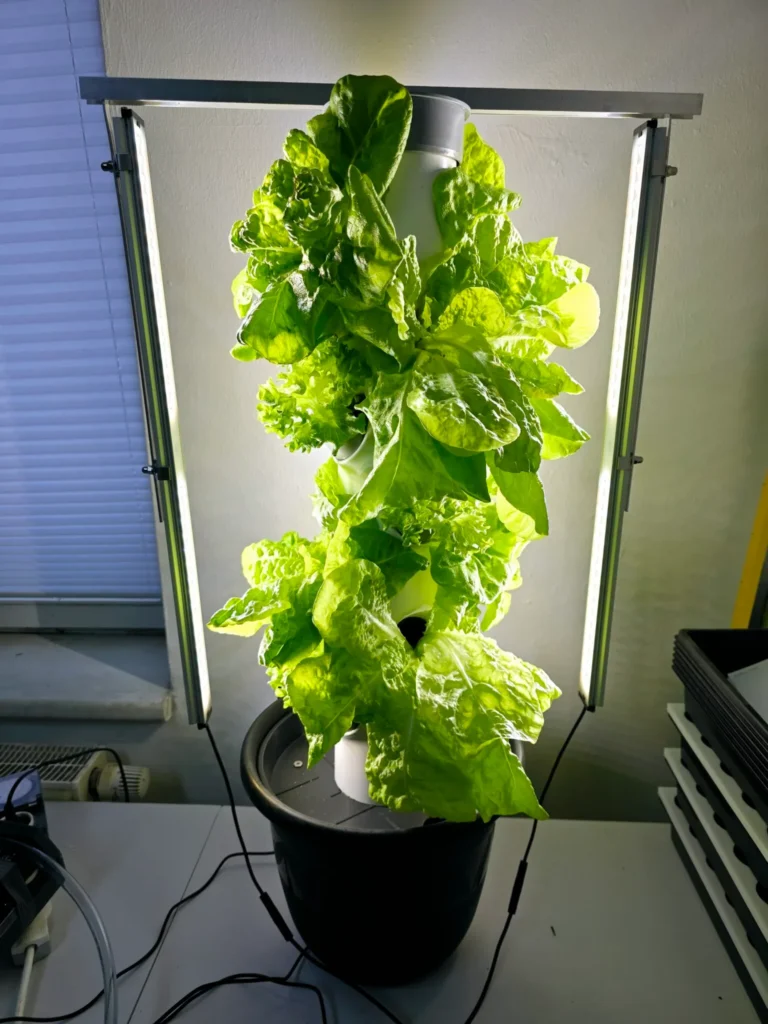
At the side of the tower, about 20 to 30 cm from the plants. Light from above hardly reaches the lower levels. More on this: lighting
How do I recognise too much light?
By brown, dry leaf edges. Then hang the lamp further away and shorten the lighting, for example from 16 to 14 hours. More on this: lighting
Which humidity is right indoors?
For seedlings and young plants I keep the humidity indoors below 60 %. If it stays higher permanently, mildew comes quickly. On top of that I air the room for about 15 minutes every morning. More on this: Humidity and air circulation
What do I need a fan for?
The gentle breeze makes the stems stronger and drives away the moist air between the leaves. During germination it stays off, otherwise the cubes dry out. It should only move the leaves slightly. More on this: Humidity and air circulation
Do I have to harden off plants before they go outside?
Yes. Under the lamp they get no UV light and would burn in the sun. At first put them out in the shade for one to two hours a day and then a little longer every day. From about mid-May the sun is enough outdoors. More on this: lighting
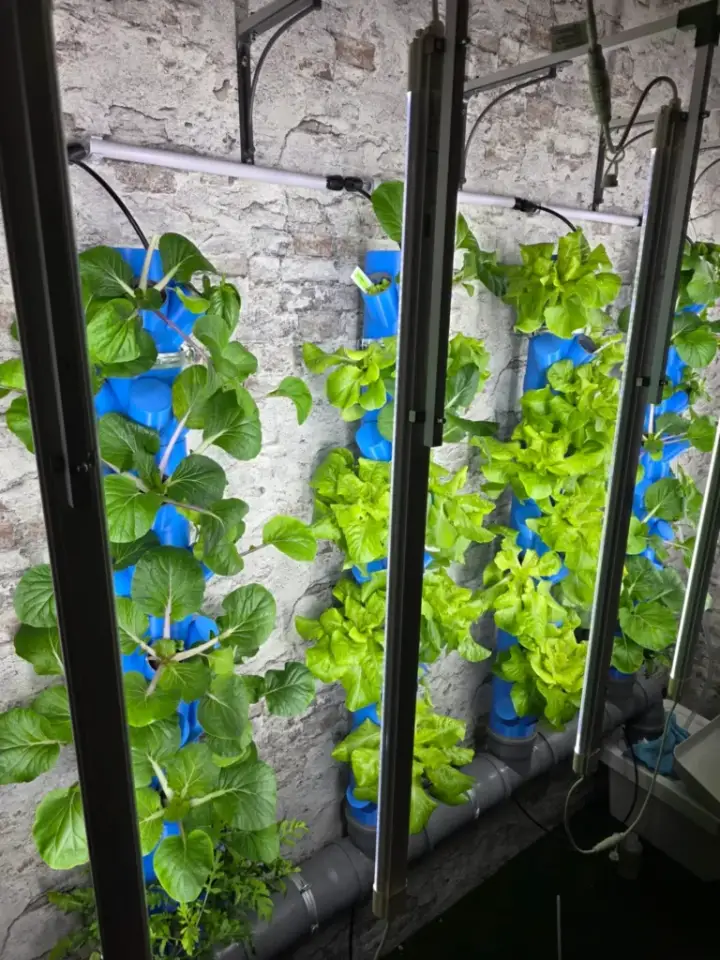
Indoors the lamp hangs at the side of the tower and is on for at most 16 hours a day.
Pump, air pump and technology
Pump times, timer and what can be automated.
How long does the pump run in the hydro tower?
Indoors 5 minutes on and 30 minutes off. Outdoors in great heat I set 15 minutes on and 15 minutes off. Only at over 40 °C in blazing sun do I sometimes let it run constantly. More on this: How often does the water run?
How do I know the pump pause is too long?
The leaves droop, with lettuce you see it immediately. Then shorten the pause. If the leaves look fresh, everything’s fine. More on this: How often does the water run?
Which timer do I need?
A digital timer with a cycle function. You set run time and pause once, and it repeats both automatically. Simple mechanical timers usually only switch in 15-minute steps. More on this: How often does the water run?
Does the air pump go on the timer?
No. Roots breathe day and night. The air pump goes straight into the socket and runs constantly, only the water pump is on the timer. More on this: How often does the water run?
When is an air pump a must?
Outdoors from 25 °C water temperature, because warm water holds less oxygen. In the seedling station and the tomato tower mine always runs, because the roots hang in still water there. More on this: The right water temperature
Can I automate my hydroponic system?
Yes. The easiest start is timers for pump and lamp. A meter that stays in the reservoir shows you EC, pH and temperature all the time. But it doesn’t replace a look at your plants. More on this: Guide for beginners
What do I do if the pump fails?
I keep a small spare pump that I connect at the top until the new one arrives. Take a quick look at the tower every day so you notice a failure early. More on this: Build a hydro tower
* Affiliate link: if you buy through it, I earn a small commission. Your price stays the same. Prices incl. VAT, as of 26.11.2026.
The Amazon products on this page are affiliate links*. I earn a commission if you buy, your price stays the same.
Pests, algae and problems
Yellow leaves, root rot, algae, mould and pests.
What do I do about yellow leaves?
Check the values first: pH between 5.5 and 6.5, EC to suit the plant, water between 18 and 22 °C. If the pH is too high, the plant struggles to reach iron and young leaves turn pale. If only the lowest, old leaves yellow, that’s often completely normal. More on this: Nutrients
How do I recognise root rot?
Healthy roots are white and strong. Rotten roots are brown, slimy and smell musty. Usually water above 24 °C, light or dirt in the reservoir or too much nutrient is to blame. More on this: pests and diseases
What do I do about root rot?
Cut off the brown roots, clean the reservoir and mix fresh nutrient solution. Let the air pump run constantly and ensure lots of air movement. More on this: pests and diseases
Why do algae form in the tank?
Algae need light and nutrients. Nutrients are always in the nutrient solution, so light decides. If light falls into the tank, algae grow. More on this: Algae
How do I prevent algae?
With a light-proof reservoir and closed lid. Cover the planting openings with support rings. You don’t need chemicals: without light and with thorough cleaning you’ll get algae under control. More on this: Algae
How do I prevent mould and mildew?
Keep the humidity indoors below 60 %, air every morning and let a gentle fan run. Don’t place the plants too close and take off film and lid right after germination. Remove affected leaves immediately. More on this: Humidity and air circulation
Is white fuzz on seedling roots mould?
No. Those are root hairs, and they’re completely normal. More on this: Seedlings in foam cubes
What helps against spider mites?
Predatory mites. They eat spider mites and are harmless to plants and people. On top of that, spray water on the leaves in the morning, because spider mites love dry, warm air. More on this: pests and diseases
How do I get rid of aphids indoors?
I dip small plants upside down into a bucket of water once a week and shake them off. Repeat several times until no more aphids come. More on this: pests and diseases
Questions about my tower, seedling equipment and your start.
What is the HydroFlex Tower?
My own plant tower. It’s flexible, you can adjust the height, for example for indoors. The slim tower with a 10 cm diameter comes for windowsill and wall, for tomatoes there’s the wide HydroFlex Tower Largo Uno. More on this: Shop
Can I grow tomatoes in the slim vertical tower?
I advise against it. Their roots grow so strongly that a slim tower stops working. My HydroFlex Tower Largo Uno with a 16 cm diameter fits 9 tomatoes, for that I use a 60 litre reservoir. More on this: Tomatoes in hydroponics
Can I build a hydro tower myself?
Yes. In my build guide I show you step by step what you need. You can get the ready-printed segments and the complete HydroFlex Tower in my shop. More on this: Build a hydro tower
What do I need a support ring for?
It holds heavy plants like kohlrabi, strawberries, tomatoes and cucumbers in the net pot and gives support to plants rinsed free of soil. It also covers the pot, so no light reaches cube and roots. More on this: Net pot
Can I put plants from the garden centre into the tower?
Yes. Carefully rinse off the soil and rinse with clear water. Then the plant goes into a net pot, and a support ring gives it support. Until the new water roots are there, the pump runs a little longer. More on this: Plants for hydroponics
Which meter do I need to start with?
A simple device that measures pH and EC is perfectly enough. If you want more precision, add a good pH pen. More on this: EC value
Which tower suits me?
That depends on space, location and what you want to harvest. My free tower advisor asks you a few questions and gives you a recommendation. More on this: Tower advisor
Where do I get help if it doesn’t work?
Write to me on WhatsApp. If you bought from me, I’m happy to help you there with your setup. More on this: Shop
* Affiliate link: if you buy through it, I earn a small commission. Your price stays the same. Prices incl. VAT, as of 26.11.2026.
* Advertising links: I earn a commission if you buy, your price stays the same.
Continue with your own growing
My book
Step by step into hydroponics
212 pages, now available on Amazon, simply explained for beginners and with videos on the topics (in German). Exactly how I grow myself: from sowing to harvest.
Tapping opens WhatsApp (provider: WhatsApp Ireland Ltd.). More in the privacy policy.
Do you have a question about this topic?
Did you enjoy this topic? Is anything missing, or do you see something differently? I keep learning all the time and I would love to hear your question and your experience. Just write it in the comments below, no sign-up needed.
 Intervalltimer(1s-999h) Zeitrelais-SteckdoseDigital timer with cycle function. Set 5 minutes on and 30 minutes off once.15,98 EURView on Amazon*To Amazon*
 Measury pH Kalibrierlösung 4.00 + 7.00Calibration solution pH 4.0 and 7.0. Use it to calibrate your meter at least once a month.21,95 EURView on Amazon*To Amazon*
 Ueomul 5-in-1 meterThe most common question: what do I need to measure? This pen measures pH, EC and temperature and is all you need to start.39,99 EURView on Amazon*To Amazon*
 UIUZMAR pH/EC monitorFor everyone who does not want to measure daily: the monitor stays in the reservoir and shows the values all the time.50,56 EURView on Amazon*To Amazon*
 Bluelab Guardian MonitorThe convenient option: measures around the clock and alerts you via app when a value gets out of range.399,00 EURView on Amazon*To Amazon*
 Mars Hydro VG40 grow lightIf you grow indoors: these LED bars deliver full-spectrum light for lettuce, herbs and vegetables.59,99 EURView on Amazon*To Amazon*
 AquaForte air pump V-10Oxygen in the water is the best protection against rotting roots. The pump runs quietly around the clock.30,80 EURView on Amazon*To Amazon*
 Wagner Blue reverse osmosis unitIf your tap water is very hard, the RO unit turns it into soft water for a clean nutrient solution.78,00 EURView on Amazon*To Amazon*